
Vol. 1, No. 1, 2023, pp. 16-21
ISSN 3030-9174
https://e-journal.ptti.info/index.php/ijase
Performance Study of Permanent Magnet Synchronous Generators in Wind Power Plants (PLTB)
1 nugrohoapri101@gmail.com; 2 ramadhoni@umy.ac.id; 3 kunnu@umy.ac.id
* Corresponding Author
Article history Received September 10, 2023
Revised October 09, 2023
Accepted November 10, 2023
Renewable Energy;
Synchronous Generator;
Wind Energy Conversion System;
Wind Turbines
Generator is a tool that functions to converts mechanical energy to be electrical energy. In the generator, there are two main components consisting of rotor as the part rotating and stator as the static one. Generator needs main driver or primary energy source to be able to spin the rotor and one of the sources is wind. Generator combined with wind turbine can work as wind power plant. A test was carried out to analyze performance of the permanent magnet synchronous generator with the power capacity of 2 kW. The test was carried out on the wind energy conversion system in Pantai Baru, Srandakan, Bantul, D.I. Yogyakarta, by installing generator to a ten meters of turbine building. The duration of the test was 19 hours in two days, i.e. 5- 6 September 2015. The result of the test was the highest performance of the generator occurred at 12.40, on 5 September 2015, with power generated of 384.48 Watt, voltage of 53.40 Volt and current of 7.2 Ampere. At the same time, the wind blew at 8.76 m/s. Overall, from the test data, the average power generated by the generator was 79.79 Watt. Meanwhile, the wind blew at 4.33 m/s.

1.Introduction
Electricity has become a necessity of life for modern Indonesian society. In 2015, the electrification ratio in Indonesia was 88.30%. In order to increase the electrification ratio in 2019 by 97.35%, the Government of the Republic of Indonesia formulated a strategic plan for the Directorate General of Electricity 2015-2019. In the strategic plan, the government is also trying to improve the energy mix by reducing the percentage of fuel as the primary energy source for electricity generation from 8.85% to 2.04%, as well as increasing the mix of other primary energy sources such as EBT by 23% [3].
EBT has economic and ecological advantages. Unlike fuel or coal, nature has provided abundant new and renewable energy sources. Utilization of EBT as a natural energy source will reduce production costs in the aspect of providing primary energy sources. EBT as a primary energy source also guarantees sustainability and environmental sustainability. One of the renewable energy sources that can be used to generate electrical energy is wind or wind, with an energy potential of 60,647 MW [6].
Utilization of wind as primary energy for generating electricity can be carried out in a wind energy conversion system (SKEA) through Wind or Wind Power Plants (PLTB). PLTB generally has the same working principle as other power plants with the main component being an electric generator. Bayu PLT utilizes wind as its primary energy source to rotate generator turbines to produce electricity. The problem that arises is that changing wind speeds certainly affect the performance of the generator. This research was conducted to study the performance of permanent magnet synchronous generators in PLTB as well as the potential of wind to be utilized in SKEA.
2.Method
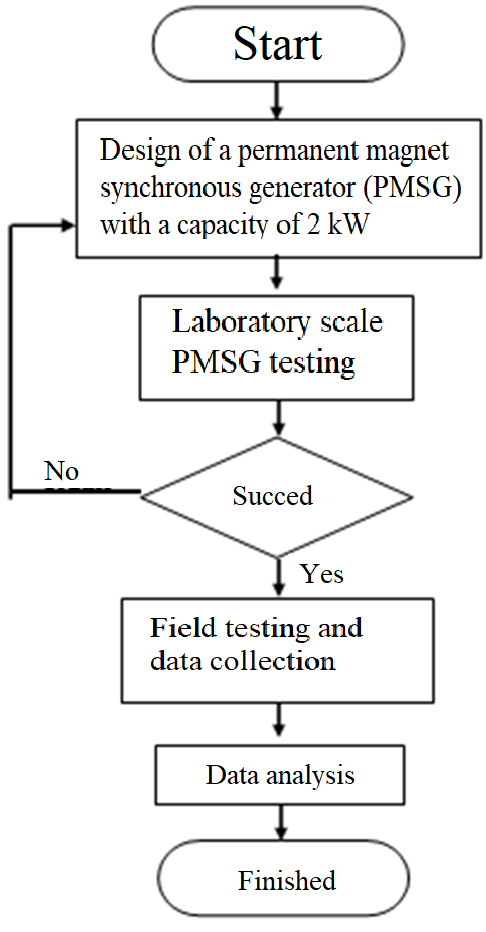
The research stages can be seen in Fig. 1. In the figure it is known that the research began with designing a permanent magnet generator (PMSG). Once the design is complete, it is then tested on a laboratory scale. The test is carried out by rotating the generator using a motor at a certain speed. If the test is unsuccessful, the PMSG needs to be redesigned. However, if successful, the research continues to the field testing stage. The generator used in this research is a 3 phase generator with a power capacity of 2 kW.
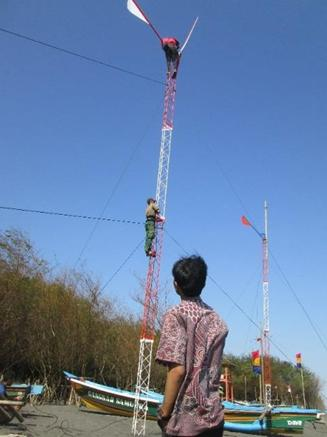
During field testing, the generator was installed in a tower 10 m high on a turbine with a horizontal axis position as shown in Fig. 2 below.
PMSG works to charge batteries with a total capacity of 48 Volts. So the electricity produced by the generator needs to be rectified first. The schematic for the research circuit or generator installation can be seen in Fig. 3 below.
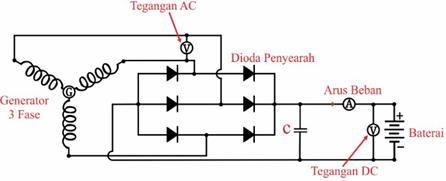
As can be seen in Fig. 3 above, measurements were made on the generator AC voltage (V AC), battery charging DC voltage (V DC) and battery charging current (I DC). Apart from that, measurements were also made of wind speed at the research location.
3.Results and Discussion
Observations and data collection were carried out for two days, starting from 12.00 local time on September 5 2015 until 12.00 local time. at 07.00 WIB local time on September 6 2015. Data is taken every ten minutes, by observing the measuring instruments that have been installed. From these observations, data on the generator's highest performance was obtained with details; the highest voltage between generator phases (V AC) is 40 Volts; DC voltage (V DC) and I load measured 53.40 Volts and 7.2 Amperes respectively. This performance was recorded at 12.40, with the wind blowing at a speed of 8.76 m/s. At that time PMSG produced 384.48 Watts of power and had a performance efficiency of 19.22%.
Below is a graph of observation results (Fig. 4 to Fig. 6) on September 5 2015, 12.00 to 12.00. 14.00 local time. This time is the time span for the generator to produce the highest performance. There are 13 (thirteen) data samples from each observation instrument such as; wind speed (m/s), V AC (Volt), V DC (Volt) and I Load (Ampere).
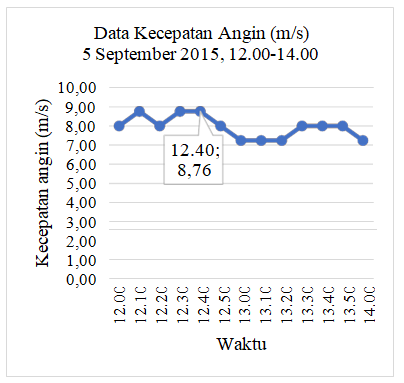
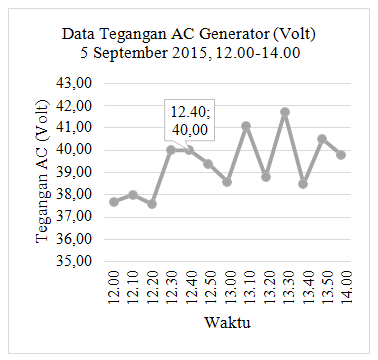
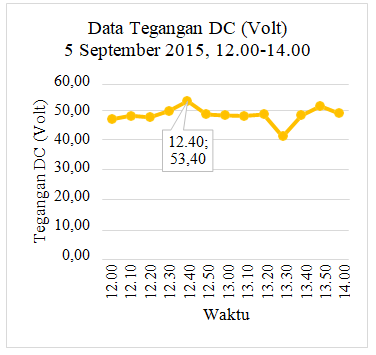
From the graph above (Fig. 4 to Fig. 6) you can see a graph of generator performance from 12.00 to 12.00. 14.00. In the graph it can also be seen that the generator's highest performance was observed at 12.40. Meanwhile, a graph of the power produced by the generator at the same time can be seen in Fig. 7 below.
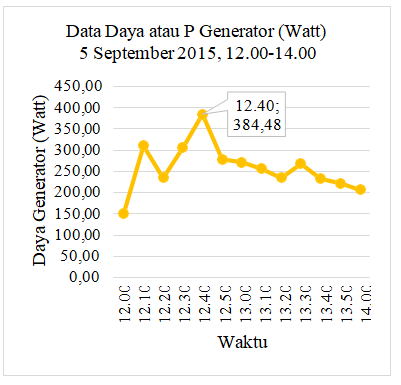
There is a correlation between wind speed which reflects generator performance. To see this relationship, you can look at Fig. 8 below.
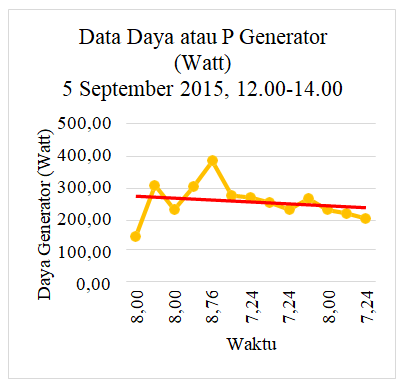
From Fig. 8 above, you can see the correlation between wind speed and the power produced by the generator. Where when the wind is blowing slowly, the power produced by the generator will also be low. Vice versa, the faster the wind blows, the more power the generator produces. This relationship can be understood by looking at the red line in the graph above (Fig. 8).
4.Conclusion
In this research, testing of the permanent magnet synchronous generator (PMSG) has been completed. Testing was carried out on September 5 2015 from 12.00 s.d. September 6 2015 at 07.00 located at Pantai Baru, Srandakan, Bantul, D.I. Yogyakarta. From this test, it was found that the generator's highest performance was observed on September 5 2015, at 12.40, with detailed data as follows; AC generator voltage is 40 Volts, DC voltage is 53.40 Volts and I load is 7.2 Ampere. At that time the generator produced 384.48 Watts of power. Thus the generator performance efficiency is 19.22%.
Generator performance is greatly influenced by the wind speed blowing at the research location. This explains the correlation between wind speed and generator performance. If the wind blows quickly, the generator will produce high power. Likewise, if the wind blows slowly, the power produced by the generator will be low.
From this research, there are several notes that can be used to improve similar research in the future, some of these notes are:
• Longer tests need to be carried out to obtain more accurate and varied data.
• Research needs to be carried out in different locations, to obtain more varied data and validate generator performance.
• It is necessary to use an observation instrument that is capable of storing or recording data (data logger) to increase the accuracy or precision of data collection.
• SKEA needs to be implemented in more coastal areas, the application of SKEA can increase the electrification ratio for remote areas in Indonesia, especially areas that directly border the coast.
• There needs to be research for more targeted implementation of PLTB based on potential wind speed data in each area. Wind speed data throughout Indonesia can be obtained from BMKG.
Author Contribution: All authors contributed equally to the main contributor to this paper. All authors have read and agreed to the published version of the manuscript.
Funding: This research received no external funding.
Conflicts of Interest: The authors declare no conflict of interest.