
Vol. 1, No. 1, 2023, pp. 34-43
ISSN 3030-9174
https://e-journal.ptti.info/index.php/ijase
Safety System for Liquefied Petroleum Gas (LPG) with Microcontoller Based Fuzzy Decisiton Tree Algorithm
b Department of Computer Science, STMIK Hang Tuah Pekanbaru, Pekanbaru, Indonesia
1 yudairawan89@gmail.com; 2 refni.wahyuni@gmail.com
* Corresponding Author
Article history Received September 10, 2023
Revised October 13, 2023
Accepted November 15, 2023
LPG;
Microcontroller;
MQ-6 Sensor;
Safety
The cause of the leak was triggered by a hose that was no longer suitable for use so that it could cause gas leaks which could have an impact on the explosion of LPG gas cylinders. By making a security system for LPG gas with a microcontroller based MQ-6 sensor using an alarm and SMS, it can help users to find out the occurrence of a leak in LPG gas. As this tool works when there is a gas leak, the MQ-6 detects that there is a leak in the LPG gas hose, so the alarm will sound. When it is on, the sound will send a command to Arduino to close the LPG gas valve. Then the buzzer alarm will send commands to the user via SMS to notify you that "gas leak has occurred". The implementation of this device is useful so that users can quickly find out leaks in the gas so that they can take steps to avoid an explosion on the gas stove. The conclusion is that this LPG gas leak detector control system can help the community, especially housewives, and can also help to avoid fires due to LPG gas leaks.

1.Introduction
Gas stoves are very practical to use by many mothers. Gas stoves are used by mothers at home for cooking because they are very practical to use. Even though they don't pay attention to pay attention when cooking while doing other work, the result is that if you have concentrated on other work, you forget about the cooking on the stove. And mothers are worried about using the gas stove because it is more likely to explode. Based on data from the questionnaire taking for 15 LPG gas users in Pekanbaru from September, there have been many cases of gas leaks and complaints about exploding gas. Basically, the potential for fire to occur will not occur if you know how to use a stove that is good and safe [1]–[4]. The cause of the leak was triggered by a hose that was not suitable for use and a hose that had been bitten by an animal, causing a fire as well as how to understand a gas stove and how to avoid burning food and prevent gas leaks that could have an impact on a gas explosion [5]–[7].
Automatic gas stove guards help users cook in the kitchen with a sense of security [8]–[11]. This tool will help gas stove users when not in the kitchen [12]–[14]. The way this tool works starts from the servo which will automatically open the knock as gas flow to the stove, then the pear sensor will detect movement in the kitchen, and when there is movement in the kitchen the SMS notification does not come in, and when there is no movement in the kitchen, the SMS notification will enter [15], [16].
Then the gas leak is known when the user wants to use the stove, when the gas leaks, the MQ-6 detects that there is a leak in the LPG gas hose, the alarm will sound [1]–[3], [7], [15], [17]–[20] When the sound is on, the sound will send a command to Arduino to close the LPG gas valve. Then the buzzer alarm will send an order to the user via SMS to notify you that "a gas leak has occurred" and the user can quickly find out the danger that will occur and can take steps to avoid an explosion on the gas stove.
Researcher 1 - Two gas sensors (MQ-6) are used to detect gas leaks at a specific location; the output is then connected to a 8051 microcontroller programmed in assembly language. A special GSM telephone with a line is connected via a relay to the output of the microcontroller [21], [22]. GSM phones are configured to send gas leak alerts in the form of a short message service message (SMS) indicating the location to other GSM phones to activate the required action immediately.
This research is designed using a prototype system which functions as a simulation in the event of a gas leak in a room using the MQ-6 sensor which detects the LPG content in the room [23], [24]. The way this tool works is if there is a gas leak, the MQ-6 sensor will detect it and then send the data to the microcontroller on the Arduino in the form of analog data.
2.Method
The method is a stage or steps systematically used in implementing and completing the solutions offered in the manufacture of an LPG gas leak safety system [25]. The method of implementation consists of the following stages:
2.1.Requirements Analysis and Definition
Here the researcher collects the complete data then performs an analysis and defines the needs to be used in the form of the MQ-6 sensor as an LPG leak detector connected to the Arduino microcontroller. The system to be made will be applied to a gas stove [26]–[28].
2.2.System Design
At this System Design stage, the researcher describes the design of the system to be built in accordance with the data analysis carried out, namely when there is a leak in the hose or gas cylinder, the device can automatically detect a leak with an alarm warning [21], [29]–[31] and an SMS will be sent to the user.
2.3.Implementation
In this implementation stage, the programs in the previous stages were translated into codes using a programming language. In this system the programming language used is C ++.
2.4.Integration and System Testing
In the Integration and System Testing stage, the integration of modules that have been created and tested is carried out to find out whether the system that has been built is in accordance with the design and whether there are still errors or not.
2.5.Operation and Maintenance
In this Operation and Maintenance stage, a system that has been run must be maintained. Maintenance also includes fixing errors that could not be found in the previous stage.
3.Results and Discussion
3.1.Hardware Design
In designing this tool starting from the servo which will automatically open the knock as a gas flow to the stove then entered. And it will detect a leak in LPG gas, then the Buzzer Alarm will turn on. When the Buzzer is on, the Buzzer will send an order to Arduino to close the LPG gas valve. Then the Buzzer Alarm will send an order to the user via SMS to give notification that "Gas leak has occurred" and the user can quickly find out the danger that will occur and can take steps to avoid an explosion on the gas stove. In this tool, the components used are ArduinoUno, PIR Sensor, MQ-6 Sensor, Servo Motor, Sim800l, Buzzer and Mobile. Mobile is a device used on stoves and can receive notifications that "a gas leak has occurred".
In this tool, the components used are ArduinoUno, PIR Sensor, MQ-6 Sensor, Servo Motor, Sim800l, Buzzer and Handphone. Mobile is a device used on stoves and can receive notifications that a gas leak has occurred.
3.1.1.Arduino Uno circuit
ATmega328 based microcontroller board (datasheet) [18], [29], [32], [33]. It has 14 input pins from digital output where 6 of these input pins can be used as PWM output and 6 analog input pins, 16 MHz crystal oscillator, USB connection, power jack, ICSP header, and reset button [34]–[37]. To support the microcontroller so that it can be used, it is enough just to connect the Arduino Uno Board to the computer using a USB cable or power with an AC-to-DC adapter or battery to run it. Can be seen in Fig. 1 Arduino circuit.

3.1.2.MQ-6 sensor circuit
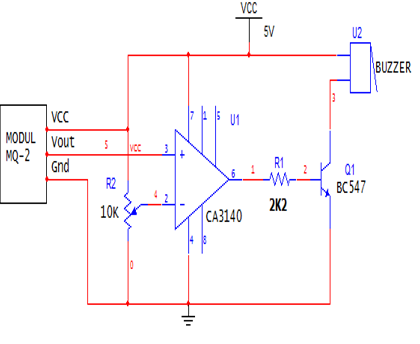
The MQ-6 sensor circuit (Fig. 2) is a component that can be used to convert a certain quantity into an analog unit so that it can be read by an electronic circuit. The MQ-6 sensor can detect / measure something, which is used to convert heat, light and chemicals into voltage and electric current. MQ-6 is a gas sensor used to detect LPG gas.
3.1.3.Pear Sensor Circuit (Passive Infra Red)
The PIR sensor is a sensor that is used to detect infrared rays from an object [31]. The PIR sensor is passive, meaning that this sensor does not emit infrared rays but only receives infrared radiation from outside [38]. The function of a motion detector that works by detecting a difference / change in temperature now and before becomes electricity. The PIR sensor circuit can be seen in Fig. 3.
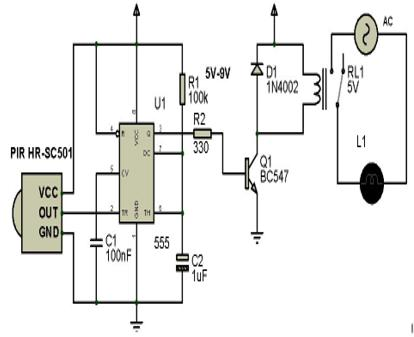
Furthermore, there is a working principle. When a movement occurs at a distance of approximately 5m in front of the PIR sensor, the movement is converted into an electric voltage which then triggers pin 2 of IC NE555. The output pin 3 of IC NE555 activates the relay driver which causes the relay to be in Normally Close mode so that AC power flows to the lamp so that the light turns on. The length of the lamp life is regulated by the R2 and C1 components which are assembled monostable with the NE 555 IC. There are several components that have been structured together including:
• PIR HR-SC501 1 piece
• Mylar 100nF 1 piece
• IC NE555 1 piece
• ELCO 1uF 1 piece
• Resistors 330, 100k @ 1 piece
• 1piece BC547 transistor
• 1piece 5V relay
• 1n4002 diode 1 piece
3.1.4.Arduino Uno microcontroller circuit with MQ-6 sensor, servo motor, GSM, PIR sensor
Serves as a connecting medium between the Arduino Uno microcontroller with motion sensors and connecting sensors to detect GAS leaks.
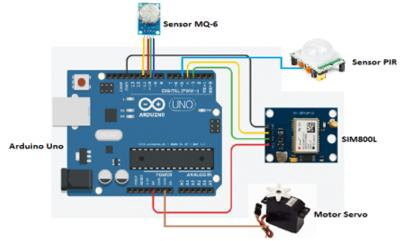
Furthermore, there are several parts of other hardware devices that are in the microcontroller place. Fig. 4 shows the results of implementing the circuit that has been assembled to detect gas leaks. The final results of the entire research series are placed on a circuit board near the gas stove. There are several components that have been assembled in a structured manner including:
• Arduino Uno (1 piece)
• SIM800L (1 piece)
• Servo Motor (1 piece)
• MQ-6 sensor (1 piece)
• PIR sensors (3 pieces)

3.2.Hardware Implementation
Implementation is one of the stages in system development, where this stage is the stage of putting the implementation of a security system for LPG gas with a microcontroller-based MQ-6 sensor using alarms and SMS, to be operated and can be seen as an effort to realize the system that has been designed.
The final result of the design that has been made and designed so as to produce a design tool as shown in Fig. 5 below where the servo motor that has been designed is then installed on the knock gas where the servo motor will be connected to Arduino using a cable in order to regulate the rotation of the knock gas. The hardware devices are used as follows:
• Gas stove
• PIR sensor
• MQ-6 sensor
• Servo Motor
• SIM800L

Furthermore, there are several parts of other hardware devices that are in the microcontroller place. In Fig. 6, shows a schematic image of the results of the component design that has been assembled and in Fig. 7 shows the results of the implementation of the circuit that has been assembled to turn off the stove automatically and detect gas leaks. The final results of the entire research series are placed on a circuit board near the gas stove. There are several components that have been assembled in a structured manner including:
• Arduino Uno (1 piece)
• SIM800L (1 piece)
• Servo Motor (1 piece)
• MQ-6 sensor (1 piece)
• PIR sensors (3 pieces)
The functions of some of the components above will be explained as follows:
• Arduino Uno [21], [39] functions as the core of a system process that aims to control and control data that comes from user input or that comes out to carry out functions on the PIR sensor, MQ-6 sensor and servo motor.
• SIM800L functions as a connecting device from Arduino Uno to Cellular Telephones [40]. In order to communicate with Arduino Uno with Cellular Telephones, electricity is needed to capture the signal on the SIM800L. Once connected, a packet credit is also required to be able to send messages and notifications to users. If there is no SIM800L then it cannot send messages and vice versa.
• Servo motor functions as a controller or driving device on the knock gas. This servo motor will rotate if there is a gas leak. Then the servo will rotate automatically.

3.3.Test Results
The results of this test have been carried out on the implementation results on hardware devices and the display results on SMS. Then it will be tested on each component of the hardware device. In the testing process, it aims to make conclusions and analyzes on hardware devices, to be able to find out whether the hardware can receive and send notifications that a leak has occurred correctly and is running well. There are two tests in this study, namely, testing the functionality of the message input, and testing the quality based on the results of the readings from the PIR sensor and the MQ-6 sensor.
3.3.1.Send leak notification messages
Functionality testing is carried out in sending gas leak notification messages. When the user wants to turn on the stove, the sensor reads the gas leak and sends a notification message to the user. The following is a test carried out based on a test scenario sending a gas leak notification message for 2 attempts.
Based on Table 1, the test carried out when a gas leak occurs is carried out with three experiments until the test is successful, in the first experiment the SMS notification can be inputted with only one number, in the second experiment the repair process can be input with more than one number, and the third test input is more than one number done successfully.
| Trial To | Scenario | Test Results Obtained | Success |
|---|---|---|---|
| 1 | Send a Gas Leak SMS notification (Trial 1) | Can Receive the results of the SMS input there is a gas leak. But failed to input more than one number. | Succeeded / In one number input |
| 2 | Sending Gas leak SMS notification (Experiment 2) | After making improvements in inputting more than one number successfully | Succeeded / in input of more than one number |
3.3.2.Quality testing
• PIR sensor distance reading suitability
Explanation of the PIR sensor distance reading test Table 2, in the test table there are different levels of sensitivity on the PIR sensor due to environmental conditions. At a distance of 10-50 cm the reading level of the PIR sensor is very sensitive in detecting someone's presence. At a sensor distance of 1-5 meters, the reading level of the PIR sensor is insensitive in detecting someone's presence because the wavelength generated by the PIR sensor is unable to detect humans.
| Trial To - | PIR Sensor Distance | Reading Information |
|---|---|---|
| 1 | 10 Cm | Detected |
| 2 | 20 Cm | Detected |
| 3 | 30 Cm | Detected |
| 4 | 40 Cm | Detected |
| 5 | 50 Cm | Detected |
| 6 | 1m | Not detected |
| 7 | 2 m | Not detected |
| 8 | 3 m | Not detected |
| 9 | 4 m | Not detected |
| 10 | 5 m | Not detected |
• The suitability of the MQ-6 sensor readings in detecting leaks
Explanation of the MQ-6 sensor reading test Table 3, in the table of tests performed on the MQ-6 sensor. At the resulting value if it is below 10 thousand, the buzzer will not sound and the valve will remain open, and at the value on the MQ sensor above 10 thousand or above the normal limit, the buzzer will sound and the valve will be closed.
| Trial To - | MQ-6 Sensor Readout | Information |
|---|---|---|
| 1 | 608 ppm | Buzzer Doesn't Sound, Valve Is Open |
| 2 | 9052 ppm | Buzzer Doesn't Sound, Valve Is Open |
| 3 | 3376 ppm | Buzzer Doesn't Sound, Valve Is Open |
| 4 | 5166 ppm | Buzzer Doesn't Sound, Valve Is Open |
| 5 | 856 ppm | Buzzer Doesn't Sound, Valve Is Open |
| 6 | 30663 ppm | Buzzer Beeps, Valve Closed |
| 7 | 16729 ppm | Buzzer Beeps, Valve Closed |
| 8 | 30214 ppm | Buzzer Beeps, Valve Closed |
| 9 | 16729 ppm | Buzzer Beeps, Valve Closed |
| 10 | 14991 ppm | Buzzer Beeps, Valve Closed |
4.Conclusion
The conclusion contains a brief statement based on the findings and results of the thesis that has been done. After testing the hardware device, the following conclusions were drawn: This tool can detect leaks in LPG gas. Can send notifications to users when LPG gas leaks occur. By using a gas leak detector system, users can take quick action to avoid an explosion on the gas stove. This LPG gas leak detector control system can help people who use LPG gas, especially housewives, and can also help to avoid fires due to LPG gas leaks.
Author Contribution: All authors contributed equally to the main contributor to this paper. All authors have read and agreed to the published version of the manuscript.
Funding: This research received no external funding.
Conflicts of Interest: The authors declare no conflict of interest.