
Vol. 1, No. 1, 2023, pp. 1-9
ISSN 3030-9174
https://e-journal.ptti.info/index.php/ijase
Design of an Ornithopter Prototype as an Educational Tool
1 okky838@gmail.com; 2 erwan.eko@sttkd.ac.id; 3 ikbal.rizki@sttkd.ac.id
* Corresponding Author
Article history Received August 19, 2023
Revised September 20, 2023
Accepted October 08, 2023
Educational Tool;
Ornithopter;
Prototype
This research discusses the creation and testing of ornithopter prototype as an educational tool because the use of lecture learning methods makes students feel bored. An Ornithopter is an unmanned aircraft that mimics the movement of bird wings while flying. This research employs balsa wood as the main material for the prototype and testing is carried out in a closed environment. The ornithopter prototype has 3 out of 4 degrees of freedom of bird wing movement, including flapping, feathering, and spanning movements. The process of making the ornithopter prototype involves designing, measuring, cutting, assembling, and the attachment of plastic components as wings and tail. Testing is conducted through flight trials using rubber as the propulsive mechanism. The test results showed that the ornithopter prototype prototype is capable of achieving flight, with an average flight duration of approximately 4.76 seconds and the number of wing flaps was 8 times per second. Comparison of characteristics between the ornithopter prototype and pigeons shows that the ornithopter prototype has approached the movement of birds when flying which pigeons can flap 8-10 times per second while flying. With 3 out of 4 degrees of freedom implemented, namely flapping, feathering, and spanning movements, the ornithopter prototype can serve as an educational tool to enhance the understanding of bird wing movements during flight.

1.Introduction
An Unmanned Aerial Vehicle (UAV) is an object capable of flying without a human pilot during flight. We assume that UAVs include Unmanned Aircraft as well as other flying objects. UAVs usually comprise Unmanned Aerial Systems (UAS) [1]. UAVs can be classified into three categories, namely based on weight, height and usability, and wings. Categories based on wings consist of three types, namely fixed wings, rotating wings, and flapping wings. Ornithopter is a UAV with flapping wings which has advantages compared to UAVs with fixed and rotary wings [2]. The working principle of the ornithopter is the same as that of an airplane; the forward motion through the air allows the wings to direct the air downward, creating lift. The vibrating movement of the wings replaces the rotating propeller. Theoretically, the vibrating wing could be set to a zero angle of attack on the wing's ascent, allowing easy passage through the air. Moves at a lower speed, thus demonstrating efficiency. Birds and insects do not fly using a simple up-and-down movement of the wings. Instead, they use some subtle mechanism that modifies the up-and-down movement vertically [3]. The ornithopter has many inherent advantages over fixed-wing and rotary-wing aircraft. Due to its high maneuverability, allowing extensive speed range, and lower power requirements, the ornithopter can be an attractive, intelligent transport and deserves more focused research and practical realization [4].
UAV aircraft with shapes and movements that mimic birds have many functions, including, namely, they can be used as a vehicle for espionage, photography, observation, and education. Learning activities still use the lecture learning method. This makes students feel bored. So that when the material is explained, many students still need help understanding and asking questions about the material they do not understand. Learning that is centered on educators will result in low results obtained by students. Using the direct practice method, students will apply the material presented earlier. Besides that, students can also prove and believe in a theory after they practice it. This is evidenced by the achievement of student learning outcomes which continued to increase starting from the initial conditions, which only reached an average skill score of 70.63. Then, in the first cycle, it increased slightly to 78.96; in the second cycle, it again increased sharply to 86.88 [5]. Learning activities certainly require learning media that are easy to obtain and understand. Therefore the author raises the topic of design entitled "Design of an Ornithopter Prototype as an Educational Tool." It is hoped that this can educate how all elements of society can reach the movement of bird wings.
Balsa wood is wood from balsa trees. In Indonesia, it is widely cultivated in the Situbondo area, East Java, making Indonesia one of the largest balsa wood-producing countries in the world. Balsa wood is divided into three types based on its density, namely: Light (< 120 kg/m^3), Medium (120-180 kg/m^3), and Heavy (>180 kg/m^3).
When a bird flies, the bird has a flight envelope that varies from soaring, flying forward at high speed, backward, perching, taking off quickly, and gliding long distances, which hardly requires any flapping of wings [6]. According to Negrello et al. (2016), bird wings have four Degrees of Freedom (DoF) or degrees of freedom. First, flapping is an angular movement to the bird's axis. This DoF produces a rolling motion on the wing. Second, Lagging is the angular movement of the vertical axis. This DoF produces a back-and-forth motion of the wing. Third, Feathering is an angular motion on an axis perpendicular to the plane produced by the axis of the flapping and lagging movements. This DoF produces variations in the angle of attack on the wings. Fourth, Spanning, namely the enlargement and contraction of the wings. This DoF implies that the wings can be spliced and folded [7]. The combination of flapping and feathering movements is the movement that makes the most significant contribution to generating thrust. Therefore, using only two DoF in designing and building an effective ornithopter prototype as an educational tool is practical [8].
2.Method
The data collection technique will use the experimental method. The method used in data collection uses quantitative data collection, which is obtained by conducting a flight test of the ornithopter prototype. Data collection was carried out by observing the movement of the ornithopter prototype when carrying out flight tests. The data collected included the length of flight time and the number of flaps of the ornithopter prototype's wings. Data analysis was done by observing the relationship between the number of wing beats and flight time. As well as observing differences in the movement of the wings of ornithopter prototypes and birds.
3.Results and Discussion
In the design and manufacture of the ornithopter prototype, the prototype is divided into three main parts: the body, wings, and tail. The shape and dimensions can be seen below.
1. Ornithopter Prototype Body Design
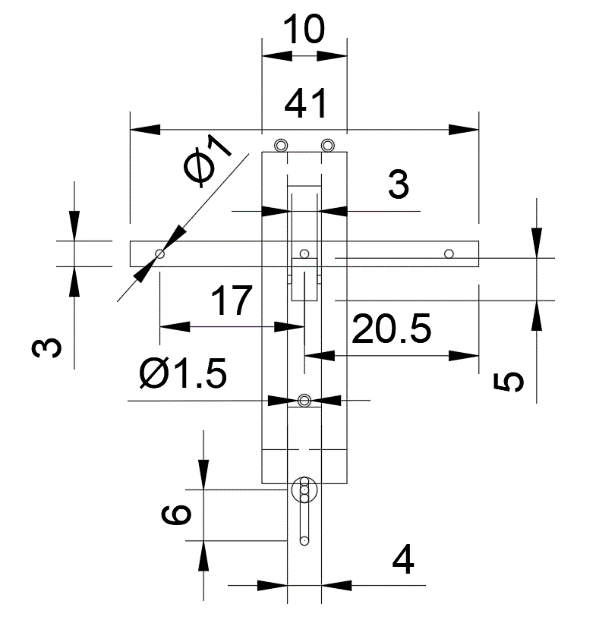
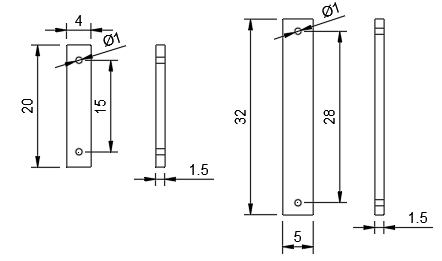
This body part is a place for the propulsion system and other parts, such as wings and tail. The shape and dimensions of the body parts can be seen in the following Fig. 1 to Fig. 3:

2. Ornithopter Prototype Wing Design
This part of the wing functions as a generator of lift and thrust so that the prototype can fly. The shape and dimensions of the wings can be seen in the following Fig. 4:

3. Ornithopter Prototype Tail Design
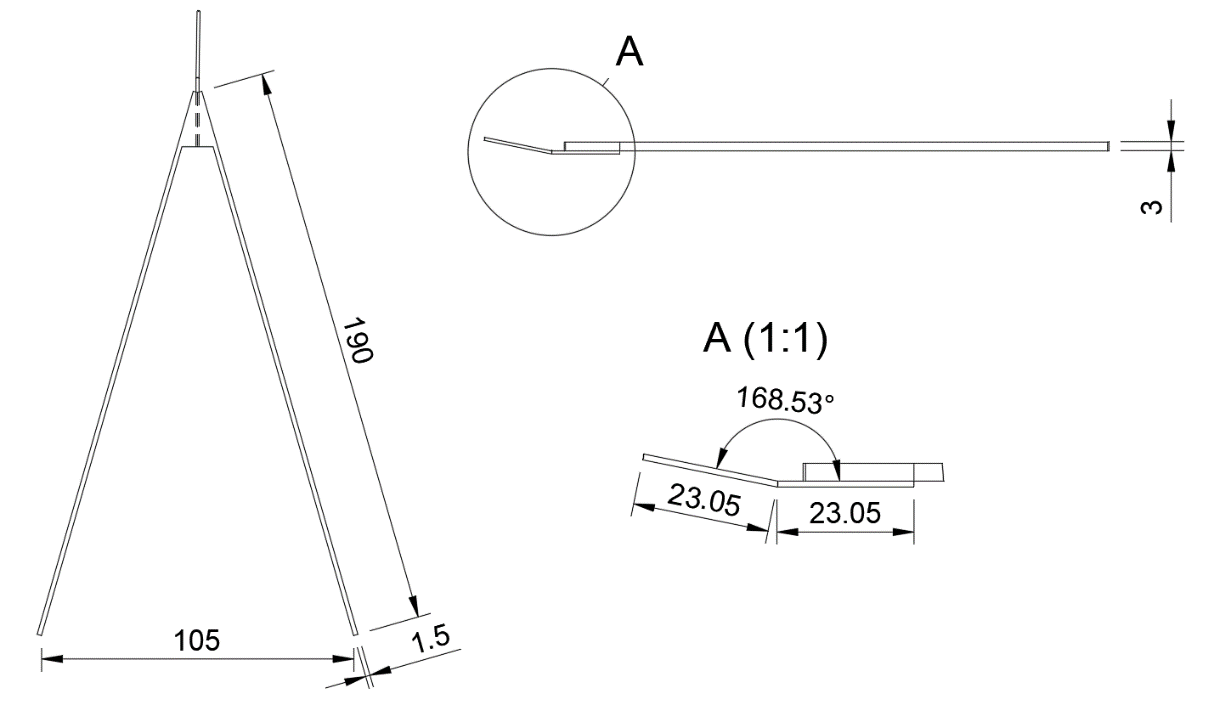
The tail section serves to maintain the stability of the flight of the ornithopter prototype. The shape and dimensions of the tail section can be seen in the following Fig. 5:
4. Making of the Ornithopter Prototype
After designing, proceed to make prototypes based on the designs prepared beforehand. The first process in making the ornithopter prototype is measuring and cutting the primary material, namely balsa wood, measuring it according to the existing design, and then cutting it. The following process in making the ornithopter prototype is measuring and cutting the stainless wire, measuring it according to the existing design, and then cutting it. The following process in making the ornithopter prototype is that after measuring and cutting the balsa wood and stainless wire, the assembly process is carried out from the balsa wood and stainless wire that has been measured and cut beforehand. Body. The following process in making the ornithopter prototype after the assembly process is carried out, then making patterns on the plastic as the tail and wings of the ornithopter prototype. After the pattern is made, it is cut according to the existing pattern. The following process in making the ornithopter prototype is making patterns and cutting the plastic, then installing plastic on the wings and tail of the ornithopter prototype.
5. Ornithopter Prototype Specifications
Overall specifications of the ornithopter prototype that has been made can be seen in the Table 1 and Fig. 6 to Fig. 7.
| Ornithopter Prototype Specifications | |
|---|---|
| Length | 363 mm |
| Height | 57.7 mm |
| Wingspan | 507.5 mm |
| Wing Chord | 130 mm |
| Weight | 11.05 g |


3.1.The Ornithopter Prototype Movement
1. Flapping
The flapping movement is the movement up and down on the wings or it can be called flapping. This movement produces lift to make flight. For more details, see the following Fig. 8 to Fig. 11.


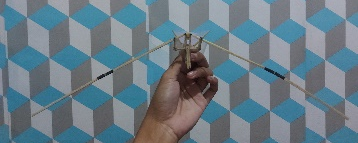

In flapping motion, during the upstroke condition, the wing will open, creating a larger surface to catch air so that when in a downstroke condition, the wing will close again, causing reduced air resistance above the wing and producing lift and forward thrust to move forward.
2. Feathering
The feathering movement produces variations in the angle of attack on the wings, which when combined with the flapping motion can produce thrust for flight. For more details, see the following Fig. 12 to Fig. 15.

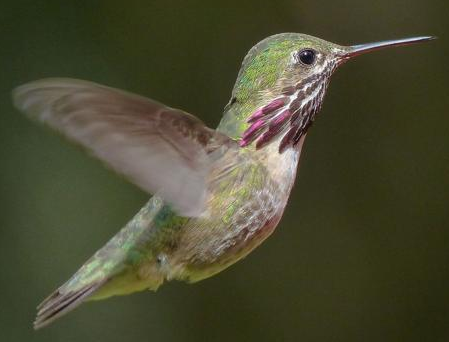

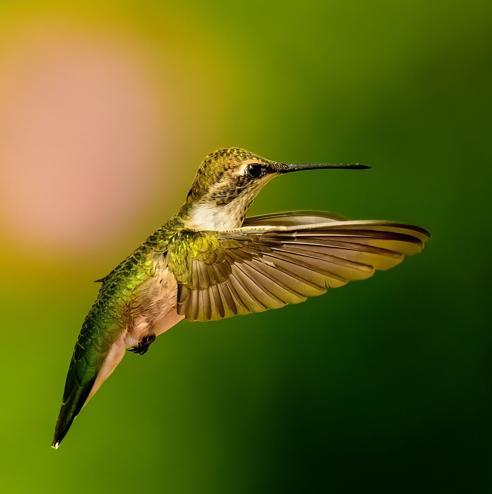
In the feathering motion, this motion produces variations in the angle of attack on the wings. By adjusting the angle of attack on the wings, the bird can reduce air resistance during the upstroke and maximize lift during the downstroke. This motion helps conserve energy and increases flight efficiency, allowing birds to maximize their flying abilities in various situations.
3. Spanning
The spanning movement is the enlargement and contraction movement of the wings. This movement indicates that the wings of birds can fold during flight. For more details, see the following Fig. 16 to Fig. 19.
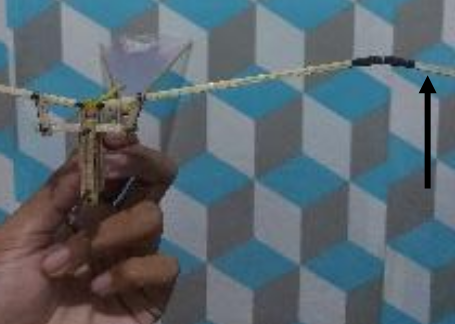

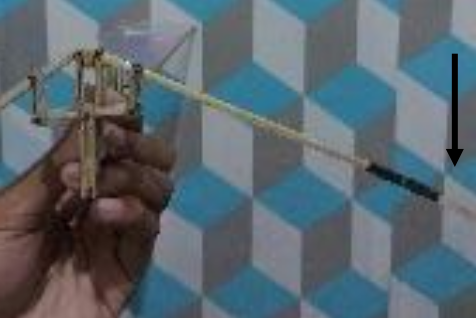

Spanning involves changing the wingspan by raising or lowering their wings. In the upstroke condition, the wing span is reduced (folded), and in the downstroke condition, the wing span is enlarged. This process makes it possible to adjust the surface area of the wing exposed to air during flight. The spanning motion allows it to adapt to different flight conditions, such as changing wind speed or flying environment. By adjusting the wingspan, this movement can optimize flight efficiency by reducing air resistance when the wings are reduced and maximizing lift when the wings are enlarged.
3.2.Ornithopter Prototype Flight Test
In collecting data using the experimental method, namely by conducting a flight test of the ornithopter prototype. The test was carried out indoors by carrying out three flights with 150 rubber rounds with a double loop length of 48 cm. The data collected is the length of the flight and the number of wing beats. The results of the flight test can be seen in Table 2.
| Flight Test | Flight Time (s) | Number Of Flaps |
|---|---|---|
| Flight Test 1 | 5.51 | 45 |
| Flight Test 2 | 4.45 | 36 |
| Flight Test 3 | 4.33 | 33 |
| Average | 4.76 | 38 |
From these data, it can be seen that the ornithopter prototype with the specifications that can be seen in Table 2 can fly with an average flight time of 4.76 seconds and an average number of strokes of 38 times, which can be concluded that the ornithopter prototype made has eight strokes. Beats per second, and it can also be seen that the results from test 1 to test 3 have decreased; this happened because the condition of the rubber used during test 1 was still new, and until test 3 used the same rubber, so the strength produced by the rubber decreased with use. At the time of testing, using 150 rounds of rubber because, during trial and error, using ≤100 rounds did not get enough strength to carry out the test, then using >150 rounds caused the rubber not to last long until it broke.
3.3.Comparison of Movement and Number of Flapping
In this study, the ornithopter prototype was made in such a way as to approximate the movement of birds during flight as much as possible. Therefore the authors took samples from pigeons due to the closeness of the dimensional aspect. The characteristics of pigeons can be seen in the Table 3.
| Characteristics of Pigeons | |
|---|---|
| Wingspan | 660 mm |
| Wing Chord | 110 mm |
| Weight | ± 390 g |
| Degree of Freedom | 3 |
| Number of Flaps / second | 8 – 10 |
Furthermore, a characteristic comparison was made between the ornithopter prototype that had been made and the dove. For a comparison of characteristics can be seen in the Table 4.
| Characteristics | Ornithopter Prototype | Pigeon |
|---|---|---|
| Wingspan | 507.5 mm | 660 mm |
| Wing Chord | 130 mm | 110 mm |
| Berat | 11.05 g | 390 g |
| Degree of Freedom | 3 | 3 |
| Number of Flaps / second | 8 | 8 - 10 |
Table 4 shows that the number of flaps of the ornithopter prototype made in this study reached the minimum number of beats in pigeons during flight. In addition, it can be seen that the ornithopter and pigeon prototypes have the same amount of DoF because both cannot make a lagging motion that functions to fly backward. From this comparison, the movement of the ornithopter prototype is close to the movement of birds during flight, which makes the ornithopter prototype used as an educational tool for all elements of society.
4.Conclusion
Based on the discussion and explanation from the previous chapter, the ornithopter prototype can be made with tools and materials that are readily available at an affordable price. This prototype's primary material uses balsa wood with a thickness of 4 mm, 3 mm, and 1.5 mm; then, the prototype is made based on the previously designed design by going through the process of measuring, cutting, gluing, and assembling. The prototype was made by paying attention to the movements of the wings of the ornithopter prototype. In addition, the ornithopter prototype that was created in this study has 3 of 4 DoF of bird wing movement and can fly using rubber power, which can represent most of how the bird's wings move during flight so that it can educate the public about what movements what happens to birds during flight. Particularly in this research, the public can learn how flapping, feathering, and spanning are done.
Author Contribution: All authors contributed equally to the main contributor to this paper. All authors have read and agreed to the published version of the manuscript.
Funding: This research received no external funding.
Conflicts of Interest: The authors declare no conflict of interest.