
Vol. 4, No. 2, 2026, pp. 52-63
ISSN 3030-9174
https://e-journal.ptti.info/index.php/ijase
AI-Driven Innovation Management: A Bibliometric and Science Mapping Analysis
b Architecture, Khon Kaen University, Thailand
c Department of Applied and Computational Mathematics, University of Washington, USA
d Department of Educational Psychology, Texas A&M University, USA
e Educational Research and Evaluation, Universitas Negeri Yogyakarta, Indonesia
f Psychology, Universitas Teuku Umar, Indonesia
1 nurfitriramdana4@gmail.com; 2 desy.p@kkumail.com; 3 laman18@uw.ed; 4 indahhamid@tamu.edu;
5 resky11pasca.2026@student.uny.ac.id; 6 Nadyaviranti555@gmail.com
* Corresponding Author
Article history Received July 04, 2026
Revised August 08, 2026
Accepted September 12, 2026
Management;
Artificial Intelligence;
Innovation Management;
Bibliometric Analysis;
Science Mapping

The rapid development of artificial intelligence (AI) has transformed innovation management by enabling organizations to enhance decision-making, knowledge management, business processes, and the development of innovative products, services, and business models. As the number of publications continues to increase and the research becomes increasingly multidisciplinary, studies on AI-driven innovation management have expanded across various disciplines, creating a need for a more systematic mapping of the field's development, thematic structure, and emerging topics. This study aims to map the evolution of AI-driven innovation management and identify its intellectual and thematic structure through bibliometric and science mapping analysis. The study employed a bibliometric approach using scientific publications indexed in the Scopus database. Data were collected on 5 July 2026 using the TITLE-ABS-KEY search field and predefined keywords related to AI-driven innovation, artificial intelligence, innovation management, and digital innovation. From an initial 180 documents, 80 English-language journal articles published between 2019 and 2026 were selected through a screening process and analyzed using descriptive bibliometric analysis and VOSviewer-based science mapping. The results indicate a substantial increase in publications since 2024, with 2025 recording the highest number of publications, totaling 43 articles. The data for 2026 represent a partial year because data collection was conducted in July and should therefore be interpreted with caution. China and India were the leading contributing countries, with 11 publications each. Business, Management and Accounting was the dominant subject area, accounting for 43% of the total publications. Keyword analysis indicates that artificial intelligence occupies a central position and is strongly connected with innovation, digital transformation, machine learning, knowledge management, and project management. The overlay visualization identifies several relatively recent themes, including generative AI, Industry 5.0, AI-driven business model innovation, leadership, and knowledge acquisition and transfer. The study concludes that AI-driven innovation management is evolving from a primarily technology-oriented focus toward a more strategic, knowledge-oriented, and interdisciplinary research domain. These emerging themes represent promising research areas based on the current bibliometric patterns and warrant further investigation.
1.Introduction
The rapid global digital transformation and the development of Artificial Intelligence (AI) have transformed the landscape of innovation management across various sectors [1]. AI increasingly plays a role in supporting organizations to improve the quality of decision-making, knowledge management, and business process efficiency, while simultaneously fostering the development of innovative products, services, and business models. Through its ability to process and analyze data, AI enables organizations to create new value, enhance productivity, and strengthen competitiveness [2]–[4]. These developments demonstrate the increasingly important role of AI in shaping innovation processes and practices amid a continuously changing business environment.
The relationship between AI and innovation has also become increasingly complex and multidimensional. AI not only supports improvements in the efficiency of existing processes but also enables organizations to identify market needs, generate new knowledge, develop innovative solutions, and design business models and organizational forms that were previously difficult to achieve through conventional approaches[5]–[7]. In innovation management, AI's ability to recognize patterns, generate predictions, and provide data-driven insights makes it relevant across various stages of the innovation process, ranging from idea generation and development to product and service development, commercialization, and innovation management [8]–[10].
The literature on AI and innovation also indicates a shift in research focus from merely examining technology adoption toward understanding how AI can shape organizational innovation capabilities. Studies by Akter et al. (2023), Cho et al. (2023), Plantec et al. (2023), and Sullivan and Wamba (2024) identify AI as an enabler that can strengthen organizations’ capacity for innovation, while other studies highlight the role of AI in corporate innovation, service innovation, new product development, and business model transformation [11]–[14]. This shift in perspective indicates that AI is becoming increasingly integrated into organizational strategic processes and can no longer be separated from discussions concerning organizational capabilities to adapt to technological changes and evolving business environments.
In addition to providing opportunities, the integration of AI into innovation management also presents new challenges. AI implementation requires adequate resource readiness, digital competencies, technological infrastructure, data governance, and organizational capabilities to integrate technology with existing organizational culture and work processes [15], [16], [17]. At the same time, the increasing use of AI has raised concerns regarding trust, accountability, risk, and the relationship between humans and AI systems in decision-making and innovation processes [18], [19], [20]. Therefore, the success of AI-driven innovation is determined not only by technological capabilities but also by an organization’s ability to develop the capabilities, governance mechanisms, and collaborative arrangements necessary to support the effective utilization of AI.
The development of generative AI technologies has further expanded the scope of this research area. Technologies such as generative artificial intelligence enable AI to be used not only for analysis and prediction but also for generating text, ideas, designs, information, and various forms of new knowledge that can support innovation activities [21]–[23]. This condition has contributed to the emergence of research on AI-driven business model innovation, human–AI collaboration, knowledge-based innovation, and changes in patterns of value creation and value management within organizations [24], [25]. Accordingly, the development of AI has produced an increasingly broad research landscape involving multiple disciplines, including management, innovation, information technology, computer science, operations, and entrepreneurship.
In line with these developments, research on AI and innovation has increased significantly in recent years. Previous studies have produced various forms of scholarly work, including systematic literature reviews, conceptual frameworks, and research agendas that examine the role of AI in innovation, organizational capabilities, and future research directions [26], [27]. These studies have provided important insights into the relationship between AI and innovation. However, the rapid growth of publications, particularly following the emergence of generative AI, highlights the need for a more up-to-date mapping of the structure and development of AI-driven innovation management research.
The research gap is not limited to the dispersion of the literature across different disciplines and publications but also concerns the limited mapping of the thematic structure, the relationships among major themes, and the emergence of new topics in AI-driven innovation management. In particular, there is a need to understand how the research focus has evolved from technologyoriented applications toward broader strategic and organizational issues, including recent developments related to generative AI, AI-driven business model innovation, knowledge management, leadership, and human AI collaboration. Therefore, an analysis is needed that not only describes publication growth but also maps the conceptual structure and changing research focus within this field.
Based on these developments and the identified research gap, this study aims to map the evolution of AI driven innovation management research through bibliometric analysis and science mapping. The analysis focuses on publication trends, country and subject area contributions, thematic structures based on keyword co-occurrence, and relatively recent research themes identified through overlay visualization. Accordingly, this study provides a systematic and up-to-date overview of the development and thematic structure of AI driven innovation management research while highlighting promising areas for further investigation based on the observed bibliometric patterns.
2.Method
This study employs a bibliometric and science mapping approach to analyze the development of research on AI-Driven Innovation Management. Bibliometric analysis is a quantitative method used to evaluate scientific publications based on publication patterns, citations, author collaboration, and relationships among research topics. This approach aims to identify research trends, the intellectual structure of the field, influential contributors, and the direction of research development in artificial intelligence-based innovation management.
The purpose of this method is to identify the intellectual structure, development and evolution of research, publication trends, collaboration networks among researchers, as well as major themes and emerging topics in the field of AI-Driven Innovation Management. In addition, this method is used to map future research directions based on citation relationships, keyword occurrences, and interconnections among scientific publications. To visualize and analyze bibliometric networks, this study employs VOSviewer, a widely used tool for mapping scientific knowledge structures.
2.1.Data Sources
The data for this study were retrieved from the Scopus database, which is recognized as one of the largest and most comprehensive abstract and citation databases of peer-reviewed literature. Data collection was conducted on July 5, 2026, using a structured search strategy based on Boolean operators. The search query focused on publications related to AI-driven innovation management. All retrieved documents were exported in CSV format for further bibliometric analysis. To ensure data accuracy and relevance, all records were carefully screened by reviewing titles, abstracts, and keywords. Any irrelevant or duplicate documents were removed during the data cleaning process.
2.2.Suitability of Criteria
To ensure the quality and relevance of the dataset, the following inclusion criteria were applied (Table 1):
1. Document type: journal articles
2. Language: English
3. Source: Scopus-indexed publications
4. Timeframe: 2019–2026
5. Keywords must relate to “AI-Driven Innovation Management,” including “artificial intelligence,” “AI,” “innovation management,” “AI-driven innovation,” “digital innovation,” and “innovation capability.”
The search strategy was conducted using Boolean operators in the TITLE-ABS-KEY field with the following query:
1. Exclusion criteria included: Conference papers
2. Topics that are not relevant to the management context
The research process was conducted in three main stages: study design, data preparation, and data analysis, ensuring a systematic and reproducible bibliometric procedure.
| Stage | Process | Description |
|---|---|---|
| Stage 1 Research Design |
Database selection | Scopus |
| Search field | TITLE-ABS-KEY | |
| Document type | Journal articles | |
| Language | English | |
| Time span | 2019–2026 | |
| Keywords | “AI-driven,” “artificial intelligence,” “AI,” “innovation management,” “AI-driven innovation,” “digital innovation,” and “innovation capability” | |
| Boolean query | The search was conducted using a combination of keywords related to AI-Driven Innovation Management within the TITLE-ABS-KEY field. | |
| Initial search results | 180 documents | |
| Stage 2 Data Preparation |
Document screening | Titles, abstracts, and keywords were screened to assess the relevance of each document to the research topic. |
| Excluded documents | 100 documents were excluded because they were not relevant to AI-Driven Innovation Management based on the title, abstract, and keyword screening. | |
| Inclusion criteria | English-language journal articles indexed in Scopus, published between 2019 and 2026, and relevant to AI-Driven Innovation Management. | |
| Final dataset | 80 documents | |
| Stage 3: Data Analysis |
Descriptive analysis | Analysis of publication trends by year, authors, countries, and institutional affiliations. |
| Keyword analysis | Keyword co-occurrence analysis was conducted to identify relationships among keywords in the research field. | |
| Thematic mapping | Network and overlay visualizations were used to identify the thematic structure and emerging research themes. | |
| Software | VOSviewer | |
| Output | Publication trends, distributions of authors, countries, and institutional affiliations, keyword network visualizations, clusters, and thematic patterns. |
3.Results and Discussion
3.1.Description of the Retrieved Literature
Table 2 presents the distribution of publications on AI-Driven Innovation Management during the 2019–2026 period. The results show that research on this topic remained very limited during the early period, with only one publication (1.25%) in 2019 and no publications identified between 2020 and 2022. Publications re-emerged in 2023, with one document (1.25%), followed by a significant increase in 2024 to 11 documents (13.75%). The most substantial increase occurred in 2025, with 43 documents (53.75%), representing the highest number of publications throughout the observation period. As of the data collection date of July 5, 2026, 24 documents (30.00%) had been identified, indicating that research on AI-Driven Innovation Management continues to develop rapidly. Overall, these findings indicate that the integration of artificial intelligence technologies into innovation management represents a relatively new emerging research field, yet it has experienced rapid publication growth in recent years, in line with the increasingly widespread adoption of AI technologies across various industrial, business, and organizational sectors.
The publication trend analysis from 2019 to 2026 reveals an initially low level of research activity, followed by a substantial increase in publications on AI-Driven Innovation Management. Based on the Scopus database (n = 80), the number of publications remained relatively low during the early period, particularly from 2019 to 2023, with annual publications ranging from zero to one document. This pattern indicates that research on AI-Driven Innovation Management was still in its early developmental stage and had not yet received substantial attention from the academic community.
| Year | Frequency | Percentage (%) |
|---|---|---|
| 2019 | 1 | 1.25% |
| 2020 | 0 | 0.00% |
| 2021 | 0 | 0.00% |
| 2022 | 0 | 0.00% |
| 2023 | 1 | 1.25% |
| 2024 | 11 | 13.75% |
| 2025 | 43 | 53.75% |
| 2026 | 24 | 30.00% |
| Total | 80 | 100.00% |
The first publication appeared in 2019, with one document (1.25%), followed by no publications during the 2020–2022 period. This condition indicates that research specifically integrating artificial intelligence with innovation management was still at an early stage and had not yet become a major focus within the academic community. During this period, AI research was predominantly directed toward algorithm development, machine learning, and its applications across various sectors, rather than toward the strategic management of innovation.
In 2023, publications re-emerged, although the number remained limited, with one document (1.25%). A substantial increase was observed in 2024, with 11 documents (13.75%), marking the beginning of the growth stage in this research field. This sharp increase reflects growing academic attention to the role of AI as a driver of organizational innovation, particularly following the rapid development of generative artificial intelligence, which has expanded opportunities for AI applications in decision-making, product development, and business process transformation [28], [29]. This shift indicates that AI is no longer regarded merely as a supporting technology, but increasingly as a strategic capability capable of generating innovation value for organizations.
The development of this research field peaked in 2025, with 43 publications (53.75%), representing the largest contribution to the overall dataset. The substantial volume of publications indicates that AI-driven innovation management has emerged as a highly relevant research topic, attracting increasing scholarly attention across multiple disciplines, including management, information systems, business strategy, and entrepreneurship. Although the 2026 data cover only part of the indexing period, the number of publications has already reached 24 documents (30.00%), indicating that the upward trend is continuing and may exceed the previous year's figure once the full year data become available. This pattern characterizes a research field undergoing a phase of expansion, accompanied by continuously increasing scholarly productivity.
The distribution of authors, countries, and institutional affiliations presented in Table 3 indicates that research on AI-driven innovation management remains relatively dispersed, with no single author demonstrating clear dominance. Among the ten most productive authors, four authors Ancillo, A.d.L., Gandía, J.A.G., Palani, P., and Thangaraju, K. each contributed two publications, while the remaining six authors contributed one publication each. This pattern suggests that the field remains in an early growth phase, with scholarly productivity not yet concentrated among a small group of researchers. Such a distribution also indicates considerable opportunities for emerging researchers to contribute to and further advance research at the intersection of AI and innovation management.
Based on the distribution of publications by country, China and India recorded the highest number of publications, with 11 publications each, followed by the United Kingdom with 8 publications, Italy and Malaysia with 7 publications each, and Spain and the United States with 6 publications each. Meanwhile, Indonesia contributed four publications. This distribution indicates that research on AI-driven innovation management has developed across various countries, with China and India making the largest publication contributions. However, publication counts primarily reflect the level of research contribution or productivity and do not directly indicate the level of collaboration or the research ecosystem capacity of each country.
At the institutional affiliation level, Universidad de Alcalá recorded the highest number of publications, with three documents, followed by Universiti Kebangsaan Malaysia, Azerbaijan State University of Economics UNEC, Symbiosis International Deemed University, and St. Joseph's Institute of Technology, each contributing two publications. Several other institutions contributed one publication each. This pattern indicates that institutional contributions to research on AI-driven innovation management are relatively dispersed across various universities, with no single institution showing strong dominance. However, the distribution of publication counts across institutional affiliations cannot be used as evidence of cross-institutional or international collaboration. Examining collaboration patterns requires additional evidence from co-authorship networks or institutional collaboration network analysis.
| Category | Author/Country/Affiliation | Number of Articles (Frequency) |
|---|---|---|
| Author | Ancillo, A.d.L. | 2 |
| Gandía, J.A.G. | 2 | |
| Palani, P. | 2 | |
| Thangaraju, K. | 2 | |
| Abbas, A. | 1 | |
| Abdul Rahman, A.W. | 1 | |
| Acar, M. | 1 | |
| Adel, H.M. | 1 | |
| Aghajani, M. | 1 | |
| Ahmad, S. | 1 | |
| Country | China | 11 |
| India | 11 | |
| United Kingdom | 8 | |
| Italy | 7 | |
| Malaysia | 7 | |
| Spain | 6 | |
| United States | 6 | |
| France | 4 | |
| Indonesia | 4 | |
| Saudi Arabia | 4 | |
| Affiliation | Universidad de Alcalá | 3 |
| Universiti Kebangsaan Malaysia | 2 | |
| Azerbaijan State University of Economics UNEC | 2 | |
| Symbiosis International Deemed University | 2 | |
| St.Joseph's Institute of Technology | 2 | |
| Birla Institute of Management Technology | 1 | |
| William Angliss Institute | 1 | |
| Federal University | 1 | |
| Catur Insan Cendekia University | 1 | |
| SRM Institute of Science and Technology | 1 |
Overall, the distribution of publications by country and institutional affiliation indicates that research on AI-driven innovation management has a relatively broad geographical and institutional distribution. China and India are the largest contributors in terms of publication output, while institutional contributions tend to be dispersed, with no single affiliation demonstrating substantial dominance. These findings provide an overview of research productivity and distribution in the field of AI-driven innovation management, whereas patterns of collaboration and relationships among researchers or institutions require separate analysis using network data.
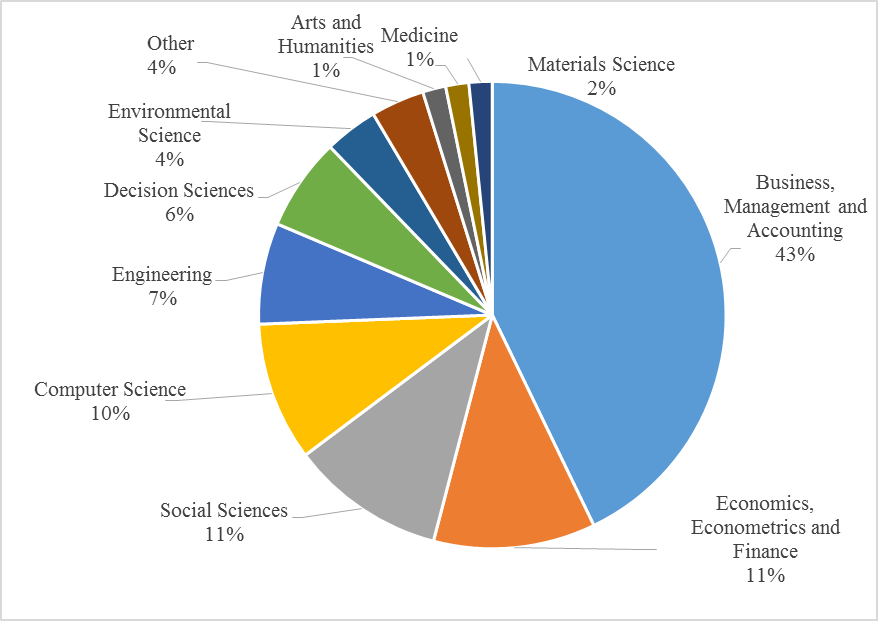
Based on the distribution of documents by subject area (Fig. 1), research on AI-driven innovation management is predominantly associated with Business, Management and Accounting, which accounts for 43% of the publications. This dominance indicates that artificial intelligence is increasingly regarded as a strategic factor in enhancing innovation, competitive advantage, and organizational decision-making. Economics, Econometrics and Finance and Social Sciences each account for 11%, followed by Computer Science (10%), Engineering (7%), and Decision Sciences (6%). This distribution reflects the increasing integration of business, economic, technological, and analytical perspectives in AI-driven innovation management. Meanwhile, Environmental Science (4%), Materials Science (2%), Arts and Humanities (1%), Medicine (1%), and other subject areas (4%) make smaller contributions. Overall, the distribution confirms the multidisciplinary nature of AI-driven innovation management, with management and business providing its primary foundation, complemented by advances in technology, computer science, and data analytics.
The observed publication trend indicates a gradual yet significant increase in research on AI-Driven Innovation Management, particularly since 2023. This growth reflects increasing scholarly interest in artificial intelligence as a driver of organizational innovation, alongside rapid advances in generative artificial intelligence, digital transformation, and data-driven decision-making. This trend is consistent with previous studies reporting a substantial increase in research on artificial intelligence, digital innovation, and innovation management, driven by the expanding adoption of AI across industries, businesses, and organizations. Furthermore, bibliometric studies indicate that the development of AI research is increasingly characterized by a multidisciplinary orientation that integrates management, information systems, computer science, and data analytics to support sustainable innovation [30]–[32]. The predominance of publications from countries such as China, India, the United Kingdom, and the United States reflects substantial research investment in AI, digital transformation, and international collaboration, which collectively contribute to the advancement of this emerging field.
Furthermore, the relatively balanced distribution of authors and institutions is consistent with previous bibliometric studies indicating that AI-driven innovation management is developing through extensive global research networks. Publication productivity remains distributed across a diverse range of researchers and institutions, rather than being concentrated within a limited group of leading academic entities.
3.2.Research Focus on AI-Driven Innovation Management
The network visualization generated using VOSviewer indicates that artificial intelligence is the most prominent keyword in the AI-Driven Innovation Management literature (Fig. 2). This prominence is reflected in its relatively large node size and central position within the network, linking it to a broad range of other research themes. Its strong associations with keywords such as innovation, digital transformation, machine learning, and knowledge management indicate that AI has emerged as a fundamental component of organizational innovation. These findings suggest that AI is increasingly conceptualized not merely as a supporting technology, but as a strategic capability for strengthening organizational innovation and enhancing competitive advantage.
The network visualization also identifies several interconnected research clusters that reflect the thematic development of AI-Driven Innovation Management. The cluster comprising innovation, project management, sustainable development, and resilience suggests that earlier research primarily examined the application of AI to enhance the effectiveness of innovation management and organizational sustainability. Meanwhile, the cluster encompassing AI adoption, technological innovation, product innovation, commerce, and big data reflects a growing emphasis on the implementation of AI to facilitate product innovation and strengthen organizational capabilities through data-driven approaches. The strong interconnections among these keywords indicate that AI adoption is increasingly recognized as a critical enabler of technology-driven innovation and organizational transformation.
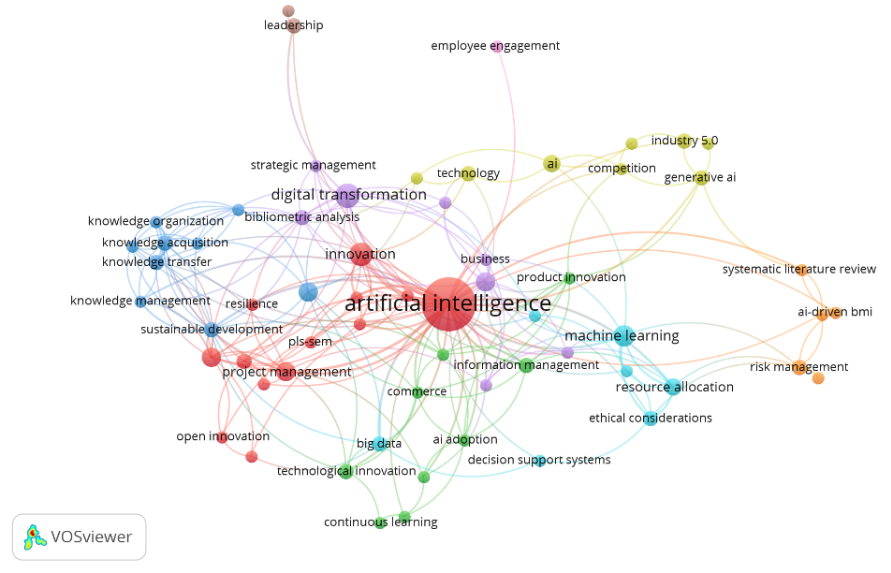
Furthermore, the cluster linking digital transformation, strategic management, business, and technology demonstrates that AI has increasingly become an integral component of organizational digital transformation strategies. This relationship is further reinforced by the cluster comprising machine learning, decision support systems, resource allocation, and ethical considerations, which highlights the use of AI to support more effective decision-making. The emergence of ethical considerations indicates a growing shift in research attention from technical aspects toward responsible AI governance. Accordingly, research on AI-Driven Innovation Management is increasingly moving toward the integration of technology with organizational strategy and sustainable governance.
On the other hand, the emergence of keywords such as generative AI, Industry 5.0, AI-driven business model innovation, and risk management reflects the emergence of new and evolving research themes. These themes are positioned at the periphery of the network, indicating that they represent relatively recent research directions with substantial potential for further development. The presence of keywords such as leadership and employee engagement also reflects growing scholarly attention to human factors in the successful implementation of AI within organizations. This development suggests that research is increasingly recognizing the interaction between technology, leadership, and human resources as critical factors in fostering sustainable innovation.
Overall, the bibliometric coupling analysis and keyword network visualization indicate that research on AI-Driven Innovation Management has evolved from a focus on technology adoption toward a more multidisciplinary approach integrating digital transformation, knowledge management, product innovation, business model innovation, and decision-making. These findings are consistent with Raina et al. (2026) and Zu et al. (2025), who demonstrate that AI constitutes a critical enabler of innovation, knowledge management, and organizational transformation [33], [34]. However, the bibliometric map reveals a clear research gap in the limited integration between emerging AI-related themes and the established core themes of innovation management. In particular, Generative AI, Industry 5.0, AI-driven business model innovation, leadership, employee engagement, and risk management remain relatively weakly connected to the main research clusters. This indicates that existing studies have not yet sufficiently explained how AI capabilities can be integrated with organizational strategy, governance, knowledge management, and human factors within a unified innovation management framework. Therefore, future research should develop more integrated models that explain these relationships and their contribution to sustainable innovation and competitive advantage.
3.3.Emerging Themes and Thematic Evolution
Fig. 3 presents an overlay visualization illustrating the evolution of research on AI-Driven Innovation Management based on the average year in which keywords appeared. The size of each node represents the frequency of keyword occurrences, while the colors indicate the publication period, ranging from blue (earlier) to yellow (more recent). The visualization shows that artificial intelligence is the central theme, with strong connections to various topics, including innovation, digital transformation, machine learning, technology, business, information management, and project management. These findings indicate that, in the early stages, research on AI-Driven Innovation Management primarily focused on leveraging AI technologies as drivers of digital transformation and organizational innovation.
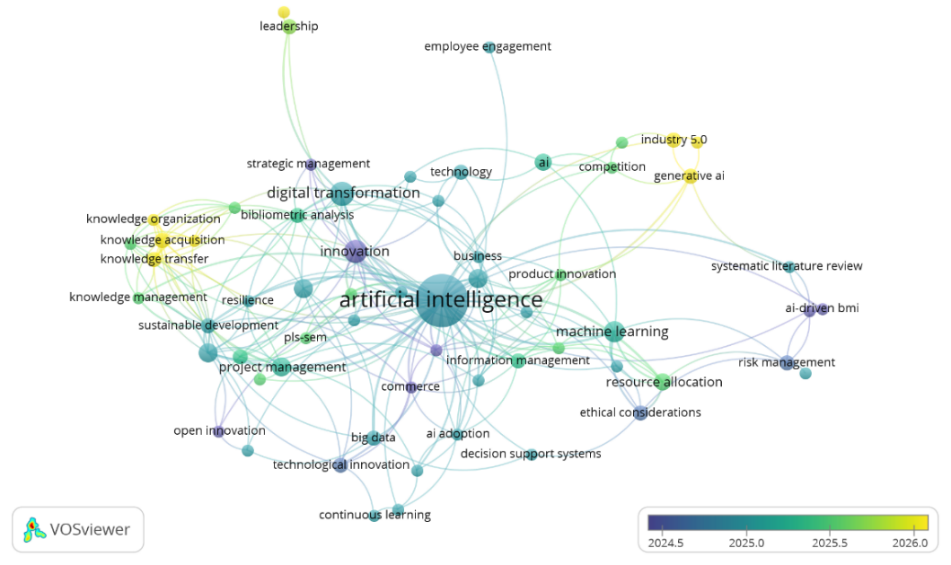
Over time, research has increasingly shifted toward more strategic issues. The recent keywords highlighted in yellow, such as generative AI, Industry 5.0, leadership, competition, knowledge acquisition, knowledge transfer, and knowledge organization, indicate that research is no longer focused solely on the implementation of AI technologies. Instead, increasing attention is being given to how AI can be leveraged to enhance leadership, knowledge management, organizational competitiveness, and innovation through collaboration between humans and technology. This shift is consistent with Mariani and Dwivedi (2024), who argue that research on Generative AI in innovation management has moved beyond technology adoption toward exploring its roles in product development, organizational creativity, innovation ecosystems, governance, and the formulation of future innovation strategies [35]. Furthermore, Huang and Chen (2025) demonstrate that human–artificial intelligence collaboration can enhance collaborative innovation by strengthening knowledge search and integration processes, thereby generating more sustainable organizational value [36].
From a knowledge management perspective, research on the impact of Generative AI on firms’ innovation performance emphasizes that the ability of AI to create, store, transfer, and apply knowledge is a key factor in enhancing organizational innovation capabilities [37]. Furthermore, recent studies in the context of Industry 5.0 indicate that the integration of Generative AI, knowledge bases, and intellectual capital plays an important role in strengthening organizational resilience, enhancing competitiveness, and promoting human-centric innovation [38]. Thus, the overlay visualization demonstrates that research on AI-Driven Innovation Management has evolved from a technology-oriented focus toward a more strategic approach that integrates leadership, knowledge management, human AI collaboration, and organizational transformation as sources of competitive advantage.
4.Conclusion
This study provides an overview of the evolution of research on AI-Driven Innovation Management and the emerging themes within the field. The results indicate a growing interest in this topic in recent years. Artificial intelligence has emerged as a central theme, frequently linked to innovation, digital transformation, machine learning, and knowledge management. Furthermore, overlay visualizations reveal increasing attention toward generative AI, Industry 5.0, leadership, and various knowledge-related issues. These findings suggest that discourse on AI-Driven Innovation Management has shifted beyond a purely technological focus to encompass organizational and strategic aspects, as well as the role of humans.
While these themes present compelling avenues for further study, they cannot yet be viewed as definitive future research directions, given that the findings are based on patterns within the specific research dataset. This study also has certain limitations. The data were drawn exclusively from English-language journal articles indexed in Scopus; consequently, research from other databases, languages, or document types was not included. Additionally, the results were influenced by the specific keywords and search strategies employed. The sample size—comprising 80 documents—should also be considered when interpreting the identified thematic structure. Therefore, future research could utilize broader data sources and search strategies to provide a more comprehensive picture of the evolution of AI-Driven Innovation Management.
Supplementary Materials: Bibliometric data from Scopus, search results obtained using Publish or Perish, and mapping results generated using VOSviewer. ChatGPT was used as an assistance tool in manuscript preparation.
Author Contribution: All authors contributed to the conceptualization, methodology, data analysis, and manuscript preparation. All authors have read and approved the final version of the manuscript.
Funding: This research received no external funding.
Acknowledgment: The authors would like to thank all parties who provided support during the conduct of this research.
Conflicts of Interest: The authors declare no conflict of interest.