
Vol. 4, No. 2, 2026, pp. 18-28
ISSN 3030-9174
https://e-journal.ptti.info/index.php/ijase
Mapping Inclusive Education Research in Indonesia: A Bibliometric Analysis of Publication Trends, Research Themes, and Future Directions
b Universitas Negeri Yogyakarta, Sleman 55281, Special Region of Yogyakarta, Indonesia
c Universitas Khairun, Jl. Akebooca Kelurahan Soa, Ternate 97725, Indonesia
d Independent Researcher, Indonesia
1 rahayunurfadillahhh@gmail.com; 2 zafrullah.2022@student.uny.ac.id; 3 fharun36@gmail.com; 4 azizah.qorri@yahoo.com;
5 sharafinamardhotillah.2024@student.uny.ac.id; 6 dinaauliatil.2026@student.uny.ac.id
* Corresponding Author
Article history Received May 28, 2026
Revised June 28, 2026
Accepted July 13, 2026
Bibliometric Analysis;
Research Trends;
Educational Equity;
Indonesia

Inclusive education plays a crucial role in ensuring equitable access to learning opportunities for all students regardless of their backgrounds and abilities. Although research on inclusive education has grown substantially, a comprehensive understanding of its development, thematic structure, and emerging trends in Indonesia remains limited. Therefore, this study aims to map the landscape of inclusive education research in Indonesia using a bibliometric approach. This study contributes to the literature by providing insights into publication trends, institutional contributions, dominant research themes, and future research directions within the Indonesian context. A total of 123 Scopus-indexed articles affiliated with Indonesian researchers were analyzed using Bibliometrix/Biblioshiny in R Program and VOSviewer to examine publication characteristics, collaboration patterns, thematic structures, and keyword evolution, providing insights into the Scopus-visible landscape of inclusive education research in Indonesia. The results indicate a significant growth in publication output and reveal that Universitas Pendidikan Indonesia, Universitas Negeri Yogyakarta, Universitas Djuanda, Universitas Negeri Jakarta, and Universitas Negeri Malang are the most productive institutions in this field. The thematic analysis identified three dominant research themes, namely Pedagogical Capacity Development, Learner Participation Dynamics, and Equity Governance Frameworks. Furthermore, overlay visualization revealed "Disability Policy" and "Madrasah" as emerging topics with strong novelty potential, indicating a shift toward policy-related and institutional perspectives in inclusive education research. In conclusion, inclusive education research in Indonesia has experienced substantial development and thematic diversification, with future studies encouraged to further explore disability-related policies and inclusive practices in madrasah settings.
1.Introduction
Education is a process aimed at developing individual potential through planned and continuous learning activities. Through education, students acquire the knowledge, skills, values, and attitudes necessary to face life's challenges [1][2]. As a vital component of human resource development, education plays a role in creating a society that is competitive, characterized, and adaptable to social change [3][4]. Therefore, various innovations and policies are continuously being developed to ensure that educational services are accessible fairly and systematically to all students [5]. One educational approach aimed at ensuring equal access and learning opportunities for all students is inclusive education.
Inclusive education is an educational approach that provides equal learning opportunities to all students regardless of physical, intellectual, social, emotional, cultural, or other backgrounds [6]–[9]. This concept emphasizes the importance of accepting diversity and providing educational services that accommodate the needs of each student within a shared learning environment [10][11]. Through inclusive education, students with special needs can learn alongside other students and receive appropriate support to achieve optimal development [12]–[14]. In addition to increasing equitable access to education, inclusive education also plays a role in fostering tolerance, respect for differences, and broader social participation [15]. Therefore, inclusive education is an important strategy in realizing a quality, equitable, and sustainable education system in Indonesia.
Inclusive education in Indonesia continues to develop in line with the government's growing commitment to ensuring equal access to education for all students [16]–[18]. Various policies, programs, and regulations have been implemented to support the provision of education that accommodates diverse learning needs, including those for students with special needs. Indonesia has also seen an increase in the number of schools providing inclusive education in various regions, as an effort to expand fairer and more equitable learning opportunities [19]. However, its implementation still faces various challenges, such as teacher readiness, facility availability, and ongoing policy support [20][21]. These challenges and developments encourage researchers to continue studying inclusive education in Indonesia.
Extensive research on inclusive education has been conducted with a variety of focuses, ranging from learning strategies, teacher competencies, student participation, and educational policy. As the number of scientific publications in this field increases, bibliometric analysis is needed to systematically and comprehensively map research developments, identify dominant themes, and determine future research directions. Various publications on bibliometric analysis in the field of inclusive education have been conducted with various focus areas, such as global trends in inclusive education research, inclusive education for students with disabilities, teacher education for inclusive education, the integration of artificial intelligence in inclusive education, and gamification to support learning for students with special needs [22]–[26]. These research findings demonstrate significant developments in the field of inclusive education and identify dominant themes and opportunities for future research.
Previous bibliometric studies have highlighted themes such as teacher attitudes, disability inclusion, teacher preparation, educational technology, artificial intelligence, and gamification in inclusive education. However, the extent to which these global trends are reflected in the Indonesian context remains unclear, given Indonesia's unique educational, cultural, and institutional characteristics. Understanding these differences is important for identifying context-specific research priorities and future directions.
This analysis focuses on mapping research developments, dominant themes, and future research directions in the field of inclusive education in Indonesia. The study used a bibliometric approach to identify publication characteristics, collaboration patterns, intellectual structure, and emerging research trends. By limiting the study to the Scopus database and publications involving Indonesian researchers, the analysis is expected to provide a more specific picture of the research landscape of inclusive education in Indonesia. Accordingly, this study addresses the following research questions:
RQ1: How has inclusive education research in Indonesia developed in terms of publication trends and institutional contributions?
RQ2: What are the dominant thematic structures within inclusive education research in Indonesia?
RQ3: What emerging topics and future research directions can be identified from the bibliometric mapping?
2.Method
This analysis aims to identify research developments, dominant themes, and future research directions in the field of inclusive education in Indonesia through a bibliometric approach. Bibliometric analysis is a quantitative method used to evaluate and map the characteristics of scientific publications based on bibliographic data, such as the number of publications, citations, keywords, authors, and research collaborations [27]–[30]. Through this approach, the intellectual structure, research trends, and opportunities for developing studies in a field can be systematically and comprehensively revealed. Before conducting the analysis, the documents were first selected using the PRISMA method (Fig. 1).
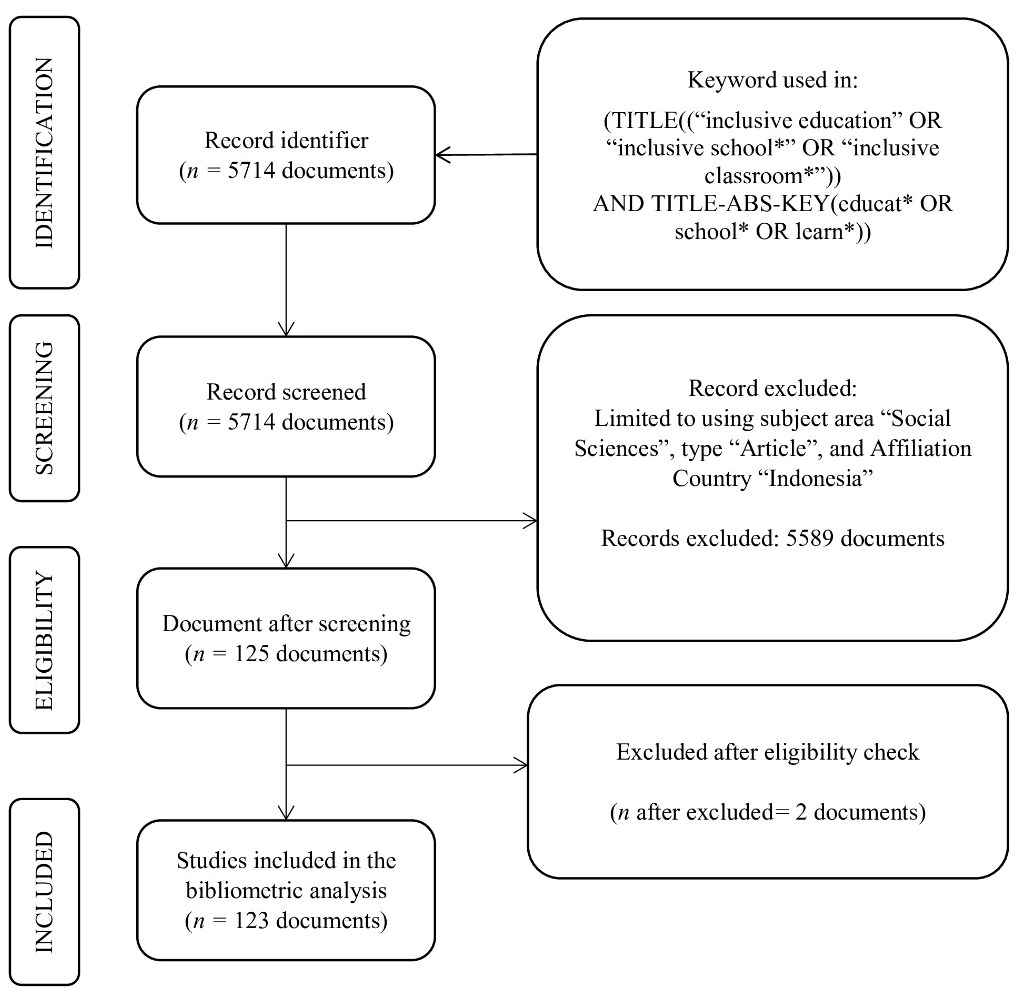
Fig. 1 illustrates the document selection process used in this bibliometric study. In the identification stage, a search was conducted in the Scopus database using the keywords ("inclusive education" OR "inclusive school" OR "inclusive classroom*")* in the title field and education, school, or learning in the title, abstract, and keywords fields. It should be noted that the dataset represents the Scopus-indexed segment of inclusive education research associated with Indonesian affiliations and does not encompass the broader body of nationally indexed or non-English publications. This initial search yielded 5,714 documents relevant to the topic. Subsequently, all retrieved records were screened using predefined criteria, including limiting the results to the subject area Social Sciences, document type Article, and affiliation country Indonesia. As a result, 5,589 documents were excluded because they did not meet one or more of these criteria, leaving 125 documents for further evaluation. In the eligibility stage, the remaining 125 documents were examined to ensure their relevance to the objectives of the study and to identify any records with insufficient bibliographic information, duplicate indexing, or limited relevance to inclusive education research in Indonesia. Through this process, two documents were excluded from the dataset. Consequently, a total of 123 documents met all inclusion criteria and were retained for the final bibliometric analysis.
Data analysis in this bibliometric study was conducted using R Program (Bibliometrix/Biblioshiny) and VOSviewer to provide a comprehensive overview of the development of inclusive education research in Indonesia. R Program was employed to analyze the main characteristics of the publications, including main information, annual publication trends, the most productive affiliations, and the relationships among titles, affiliations, and keywords through a three-field plot. Meanwhile, VOSviewer was used to map research focus based on keyword co-occurrence networks and to identify emerging topics with novelty potential through overlay visualization analysis. The combination of these two software tools enabled a systematic and in-depth examination of the intellectual structure, dominant themes, and future research directions in the field of inclusive education.
3.Results and Discussion
3.1.Main Information
The bibliometric dataset demonstrates a rapidly growing research field, as reflected by the high annual growth rate, extensive collaboration among authors, and substantial international research partnerships [33]. Moreover, the considerable citation impact, large reference base, and diverse range of author keywords indicate a well-established and continuously evolving body of knowledge with significant potential for future research development.
Fig. 2 presents the bibliometric characteristics of the publications analyzed in this study. The dataset consists of 123 articles published across 81 sources, involving a total of 428 contributing authors. The annual growth rate of 25.99% indicates a growing academic interest in inclusive education research within the Indonesian context. Furthermore, the average of 4.24 authors per document suggests that research in this field is predominantly conducted through collaborative efforts. The international co-authorship rate of 25.2% further demonstrates that this research area has attracted attention beyond national boundaries and has become increasingly connected to global scholarly discussions on inclusive education.
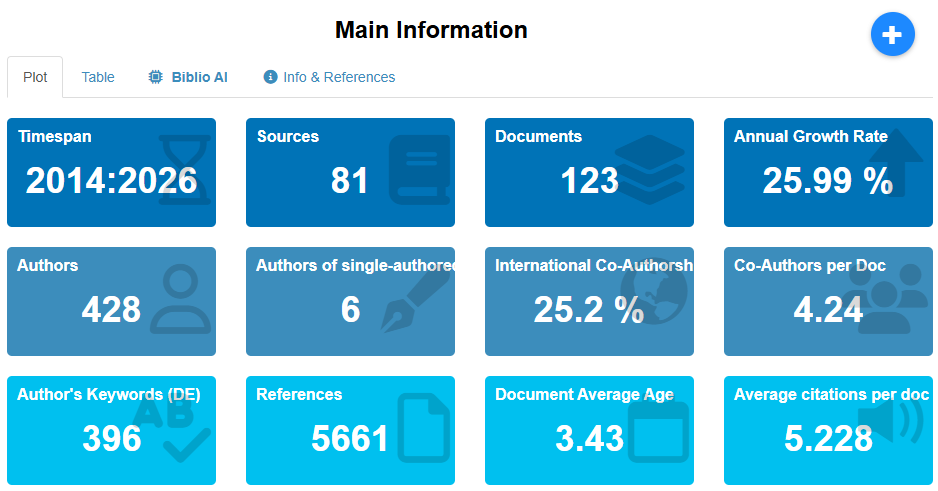
From a scholarly development perspective, the average of 5.23 citations per document indicates that existing studies have generated a meaningful academic impact and have been referenced by subsequent research. The substantial number of references (5,661) reflects a strong theoretical and empirical foundation underpinning the literature in this field. In addition, the presence of 396 author keywords and 94 Keywords Plus highlights the diversity of topics explored by researchers, encompassing various dimensions of inclusive education and support for learners with diverse needs. This thematic diversity suggests that the field continues to evolve and provides significant opportunities for identifying dominant research themes, uncovering existing research gaps, and determining future directions for scholarly inquiry.
3.2.Publication Trends
The analysis of publication trends using the R program aims to examine the growth and development of research output over time [33][34]. It also helps identify patterns of scholarly productivity and reveals the evolution of research interest within the field. Fig. 3 shows the trend in the number of publications on inclusive education in Indonesia, which gradually increased over the observation period. At the beginning of the period, the number of publications was relatively low, at only one to three articles per year, but then began to increase in 2019 to 11 publications. A more significant increase occurred in 2020, with 16 publications, reflecting increased academic attention to the issue of inclusive education. However, the number of publications decreased in 2021 to seven articles before increasing again in the following years. This pattern indicates that, despite fluctuations, the overall research trend remains positive.
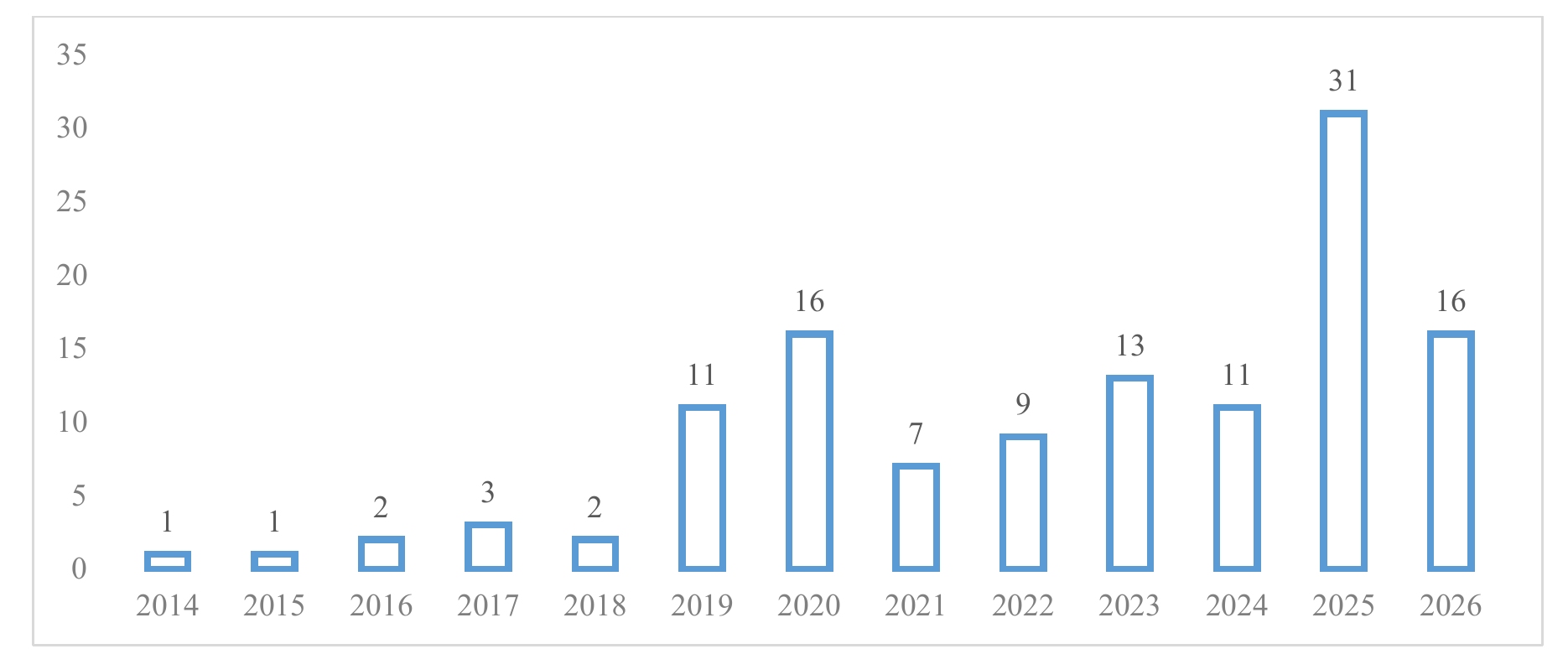
Subsequent publication developments show that research productivity continued to grow, peaking in 2025 with a total of 31 articles. This number was the highest during the observation period and demonstrates the growing interest of researchers in studying various aspects of inclusive education in Indonesia. Following this peak, data for 2026 recorded 16 publications, which is still relatively high compared to most previous years. It should be noted that the number of publications in 2026 may not reflect the full number of articles indexed, as the year is still ongoing. Overall, this trend indicates that research on inclusive education in Indonesia continues to grow and is expected to remain a focus of study in the future.
3.3.The Most Higher Affiliations
Table 1 presents the five leading institutions contributing to inclusive education research in Indonesia. Universitas Pendidikan Indonesia ranked first with 11 publications (8.94%), followed by Universitas Negeri Yogyakarta with 10 publications (8.13%). Universitas Djuanda and Universitas Negeri Jakarta shared the third position, each contributing 9 publications (7.32%), while Universitas Negeri Malang ranked fifth with 7 publications (5.69%). The relatively close publication counts among these institutions indicate that research productivity is distributed across several major universities rather than being concentrated within a single institution. Furthermore, all five institutions demonstrate collaborative research practices, reflecting the importance of institutional and interdisciplinary partnerships in advancing inclusive education research in Indonesia.
| Rank | Institution | Location | n | % |
|---|---|---|---|---|
| 1st | Universitas Pendidikan Indonesia | Bandung, West Java, Indonesia | 11 | 8,94% |
| 2nd | Universitas Negeri Yogyakarta | Yogyakarta, Special Region of Yogyakarta, Indonesia | 10 | 8,13% |
| 3rd | Universitas Djuanda | Bogor, West Java, Indonesia | 9 | 7,32% |
| 4th | Universitas Negeri Jakarta | Jakarta, Indonesia | 9 | 7,32% |
| 5th | Universitas Negeri Malang | Malang, East Java, Indonesia | 7 | 5,69% |
3.4.Three-Field Plot
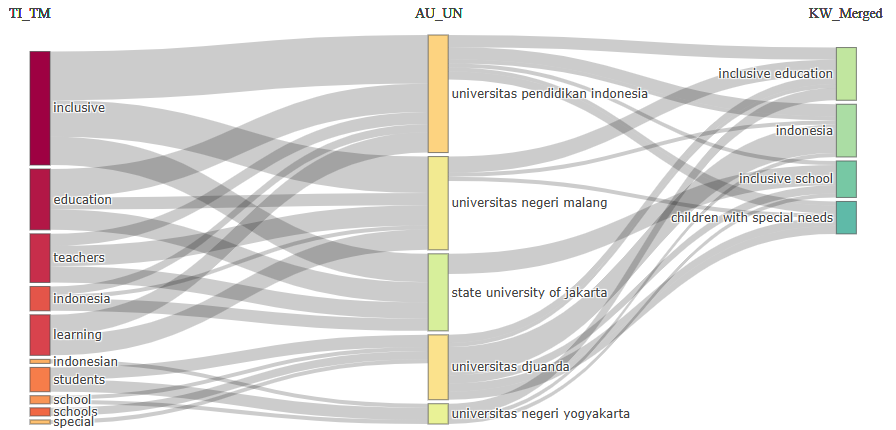
The three-field plot (Fig. 4) demonstrates that the publication titles are predominantly centered on the terms "inclusive" and "education", which exhibit the strongest connections with the leading institutional affiliations. Universitas Pendidikan Indonesia appears as the most prominent contributor, receiving the largest flow from the dominant title terms, followed by Universitas Negeri Malang, Universitas Negeri Jakarta, Universitas Djuanda, and Universitas Negeri Yogyakarta. This pattern indicates that these institutions have played a substantial role in producing research focused on inclusive education. The distribution of links also suggests that the leading institutions contribute to multiple research topics rather than concentrating on a single area of investigation.
On the keyword side, "inclusive education" emerges as the dominant research theme and is strongly connected to nearly all major institutional affiliations. Other frequently associated keywords include "Indonesia", "inclusive school", and "children with special needs", indicating that the literature primarily emphasizes the implementation of inclusive education within the Indonesian context and educational services for learners with special needs. The strong interconnections between publication titles, institutional affiliations, and keywords demonstrate a high level of thematic consistency across the research landscape. Overall, the three-field plot reveals that the most productive institutions consistently contribute to the core themes of inclusive education while also supporting the development of related topics concerning inclusive schools and children with special needs.
3.5.Focus Research
The cluster titled "Pedagogical Capacity Development" focuses on developing pedagogical capacity to support learning for students with diverse needs. This is reflected in the emergence of keywords such as Blended Learning, Instructional Strategy, Inclusive Classroom, Special Education Teacher, and Student Teachers, which highlight the importance of teacher competency and learning innovation. The presence of keywords Education Computing and Higher Education also indicates a focus on the use of technology and strengthening the capacity of educators through higher education. Furthermore, the theme of Diversity and Special Needs indicates efforts to accommodate the diversity of student characteristics in the learning process. Overall, this cluster illustrates the research focus on improving the quality of learning practices and educator readiness in creating learning environments that are responsive to student needs (Fig. 5).
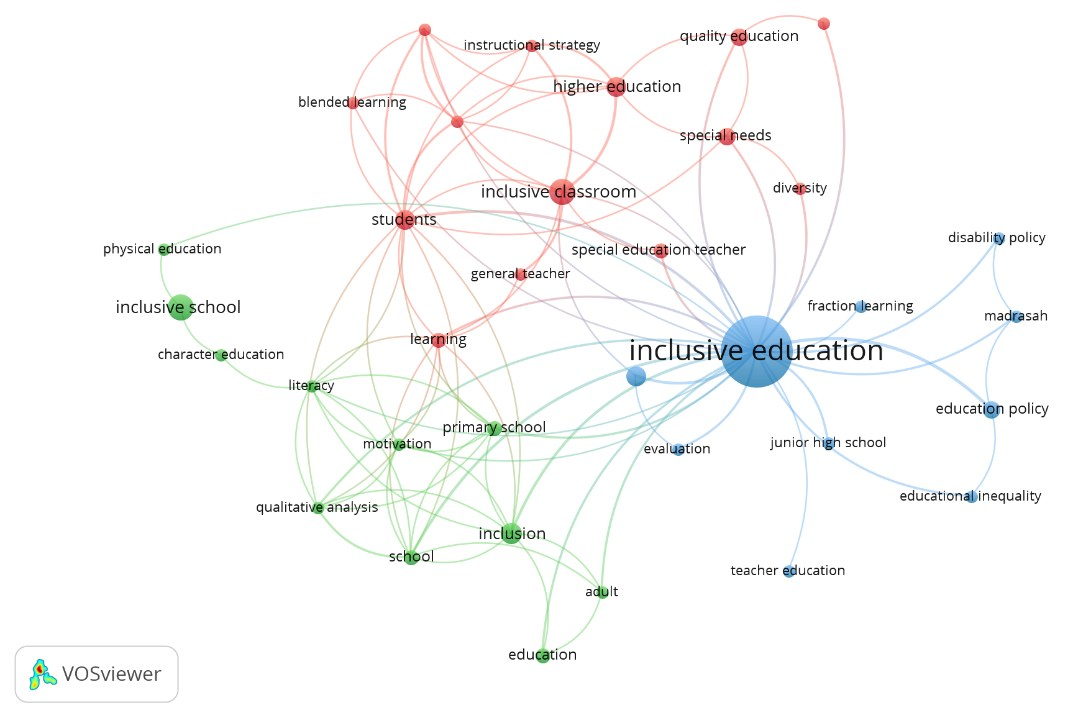
The cluster titled "Learner Participation Dynamics" highlights various factors that influence student engagement and participation in the learning environment. Keywords such as Motivation, Literacy, Character Education, and Physical Education indicate that the research focuses not only on academic aspects, but also on the development of student character, skills, and well-being. The presence of Primary School and Adult indicates that the research focuses on various age groups and educational levels. Furthermore, the keyword Qualitative Analysis indicates the dominance of approaches that seek to understand the experiences and dynamics of student participation in depth. This cluster reflects researchers' attention to factors that support active student engagement in the learning process.
The cluster titled "Equity Governance Frameworks" focuses on policy aspects, equitable access, and governance that support the provision of education for all students. Keywords such as Disability Policy, Education Policy, and Educational Inequality demonstrate a strong focus on regulation and efforts to reduce educational disparities. The presence of Teacher Education, Evaluation, and Madrasah indicates that research in this cluster also addresses policy implementation in various institutional contexts and its evaluation processes. Furthermore, the presence of Elementary Schools and Junior High Schools demonstrates that equity and governance issues are a concern at various levels of education. Overall, this cluster illustrates the research focus on developing policy frameworks and systems capable of supporting more equitable and sustainable access to education. By using the keyword occurrence ≤ 2, 35 items were obtained, divided into 3 clusters, which can be seen in Table 2.
| No | Cluster Color | Keywords | Cluster Name |
|---|---|---|---|
| 1 | Red (14 items/40%) |
Blended Learning, Diversity, Early Childhood Education, Education Computing, General Teacher, Higher Education, Inclusive Classroom, Instructional Strategy, Learning, Quality Education, Special Education Teacher, Special Needs, Student Teachers, Students | Pedagogical Capacity Development |
| 2 | Green (11 items/31.42%) |
Adult, Character Education, Education, Inclusion, Inclusive School, Literacy, Motivation, Physical Education, Primary School, Qualitative Analysis, School | Learner Participation Dynamics |
| 3 | Blue (10 items/28.58%) |
Disability Policy, Education Policy, Educational Inequality, Elementary School, Evaluation, Fraction Learning, Inclusive Education, Junior High School, Madrasah, Teacher Education | Equity Governance Frameworks |
3.6.Keyword Novelty
The yellow keywords in the VOSviewer (Fig. 6) overlay map represent topics that emerged during the most recent period of research development. In this visualization, "Disability Policy" and "Madrasah" appear as the brightest keywords, indicating that these two themes are beginning to receive greater attention than more established themes such as "Inclusive Education", "Inclusive Classroom," or "Inclusive School." Their position on the periphery of the network also indicates that these themes are still relatively new and have not yet been strongly integrated into mainstream research. This finding indicates a shift in research focus toward more specific policy aspects and institutional contexts within inclusive education.
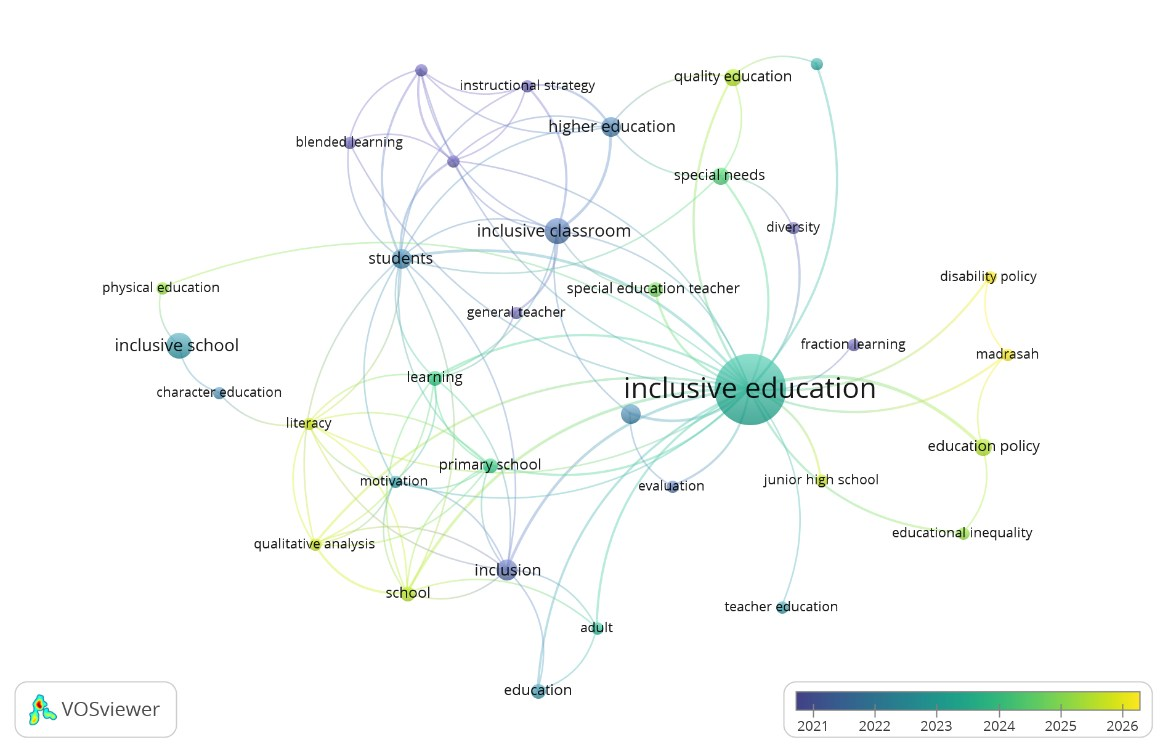
The emergence of "Disability Policy" as a new buzzword indicates growing attention to regulation, policy implementation, and the protection of the rights of students with disabilities. This topic is crucial because the success of inclusive education is determined not only by classroom learning practices but also by policy support that ensures equal access and opportunities for learning. Meanwhile, the emergence of "Madrasah" as a new buzzword indicates that research is beginning to explore inclusive education in religious-based educational institutions, a previously underserved area. This situation opens up opportunities to examine how the characteristics, challenges, and practices of inclusive education are implemented in the madrasah context. Therefore, both keywords can be seen as promising research areas to be developed in future studies.
In addition to these two keywords, the overlay visualization shows that most other themes are still dominated by blue to green, indicating they have been extensively researched in previous periods. This color difference indicates that "Disability Policy" and "Madrasah" are themes that are in an earlier development phase compared to other key topics. From a bibliometric perspective, themes with more recent emergence often reflect the direction of future research developments because they still have ample room for exploration. Therefore, future research can utilize these two themes to produce more innovative and relevant contributions to the development of inclusive education in Indonesia.
4.Conclusion
This study mapped the development of inclusive education research in Indonesia through a bibliometric analysis of 123 Scopus-indexed publications. The findings revealed a growing research interest in inclusive education, with three dominant themes identified: Pedagogical Capacity Development, Learner Participation Dynamics, and Equity Governance Frameworks. In addition, "Disability Policy" and "Madrasah" emerged as recently developing topics that may warrant further scholarly attention. This study has several limitations. The analysis was restricted to Scopus-indexed articles affiliated with Indonesian researchers, limited to the Social Sciences subject area, and based on a title-focused search strategy. Consequently, the findings represent the Scopus-visible landscape of inclusive education research in Indonesia and may not fully capture studies indexed in national databases or publications using alternative terminology.
Future research should investigate the implementation and effectiveness of disability-related policies, evaluate inclusive practices within madrasah settings, compare inclusive education implementation across different educational institutions, and explore challenges in underrepresented regions. Such efforts may contribute to a more comprehensive understanding of inclusive education and support evidence-based policy development in Indonesia.
Supplementary Materials: No supplementary materials are available for this study.
Author Contributions: Conceptualization, methodology, project administration, supervision, and writing—review and editing, R.N. and Z.Z.; data curation, formal analysis, investigation, software, validation, and writing—original draft preparation, Z.Z. and R.N.; visualization, F.H. and Q.A.; literature search, data collection, and resources, S.M.P. and D.A.W.; validation and proofreading, F.H., Q.A., S.M.P., and D.A.W. All authors contributed to the interpretation of results, critically reviewed the manuscript, and approved the final version of the manuscript.
Funding: This research received no external funding.
Acknowledgments: The authors would like to express their sincere gratitude to Universitas Negeri Yogyakarta for its academic support and encouragement throughout the completion of this research.
Conflicts of Interest: The authors declare no conflict of interest.