
Vol. 4, No. 1, 2026, pp. 29-49
ISSN 3030-9174
https://e-journal.ptti.info/index.php/ijase
Socio-Economic Status and Students' Financial Numeracy: A Systematic Literature Review and Meta-Analysis of International Evidence
b Electrical Engineering Education, Faculty of Engineering, Universitas Negeri Yogyakarta, Yogyakarta, Indonesia, 55281
c Mathematics Education, Faculty of Mathematics and Natural Science, Universitas Negeri Yogyakarta, Yogyakarta, Indonesia, 55281
d University of Exact and Social Sciences, Uzbekistan, 100069
e Departement of Monitoring and Evaluation, The Open University of Tanzania, Dar es Salaam, 23409, Tanzania
f Departement of Chemistry, University of Education, Winneba, Ghana
1 hanifahmaratush.2025@student.uny.ac.id; 2 samsul_hd@uny.ac.id; 3 edy_supriyadi@uny.ac.id; 4 heri_retnawati@uny.ac.id;
5 riskysetiawan@uny.ac.id; 6 asmakhoirunnisa.2025@student.uny.ac.id; 7 aziza.akramova.1094@gmail.com; 8 ayshamussa22@gmail.com;
9 ametepeyisrael2123@gmail.com
* Corresponding Author
Article history Received May 11, 2026
Revised June 08, 2026
Accepted July 10, 2026
Financial Numeracy;
Meta-Analysis;
Educational Equity
This study aims to provide a quantitative synthesis of the association between socioeconomic status (SES) and students' financial numeracy. The systematic review followed PRISMA guidelines and included 26 journal articles published between 2021 and 2026, representing 166,427 participants from 15 countries. Using a random-effects model, the meta-analysis found a statistically significant moderate positive association between SES and financial numeracy, r = 0.31, 95% CI [0.21, 0.40], p < .001. However, substantial heterogeneity was observed, I² = 98.4%, indicating considerable variation across studies. Subgroup analyses suggested that the SES–financial numeracy relationship was stronger in developing countries and rural geographical contexts, where family resources may play a greater role in students' financial learning opportunities. The association also appeared more pronounced at the university level, suggesting a widening SES gap across educational progression. No substantial evidence of publication bias was detected. This study concludes that SES is an important international predictor of students' financial numeracy and highlights the need for early, inclusive, and context-sensitive financial mathematics education, particularly for students from lower-SES backgrounds.

1.Introduction
Financial numeracy has become an essential competence for students in contemporary education because young people are increasingly required to understand, interpret, and apply numerical information in financial contexts. In this study, financial numeracy refers to students' ability to use numerical and mathematical reasoning in financial contexts, such as budgeting, interest, taxation, savings, risk, and financial decision-making. The expansion of digital payments, online transactions, credit systems, savings products, and personal financial decision-making requires students to possess not only general financial knowledge but also the ability to reason numerically about money, risk, budgeting, interest, and long-term financial consequences. The importance of these skills is supported by global meta-analytic evidence indicating that numerical aptitude significantly predicts various learning outcomes and broader mathematical abilities [1]. The expansion of digital payments, online transactions, and personal financial decision-making requires students to possess advanced numerical reasoning. Recent global research highlights that numeracy assessment is currently transitioning into a digital era, necessitating the development of more sophisticated diagnostic tools to bridge the gap between traditional mathematical skills and functional financial [2]. However, previous studies have shown that students' financial numeracy and financial numeracy-related outcomes remain uneven across educational levels and national contexts [3][4][5]. This issue is particularly important because limited financial numeracy may reduce students' ability to make informed financial decisions, participate effectively in economic life, and develop responsible financial behavior from an early age [6].
One of the major problems identified in the literature is that students' financial numeracy is not shaped only by schooling, but also by socio-economic status (SES). From the perspective of human capital theory, students from higher-SES families are more likely to receive academic support, learning materials, and exposure to financial concepts at home [7]. Meanwhile, cultural capital theory suggests that parental education and family practices may influence how students develop familiarity with financial language [8], numeracy-related reasoning, and financial decision-making habits. Empirical studies have shown that SES-related variables, such as family background, parental education, and wealth level, are associated with students' financial knowledge, financial confidence, and numeracy-related outcomes [4][9][10][11].
Nevertheless, the empirical findings on the relationship between SES and students' financial numeracy remain inconsistent. Some studies have reported weak or near-zero associations between SES and financial numeracy-related outcomes, suggesting that school exposure, curriculum, or individual learning experience may reduce the influence of family background [12][13]. In contrast, other studies have found moderate to strong associations, indicating that socio-economic advantage may substantially shape students' financial numeracy, especially in contexts where access to financial education and household learning resources is unequal [14]. These contrasting findings indicate that the SES, financial numeracy relationship cannot be understood as a uniform pattern across all educational and socio-economic contexts.
Previous research has also shown that the strength of the SES, financial numeracy association may vary across macro-level and micro-level conditions. At the national level, studies conducted in developed and developing countries may produce different patterns because students' access to financial institutions [8], educational resources, digital finance, and school-based financial education differs across economic contexts [5][10]. At the school level, geographical location may also matter because students in urban areas—defined here as major towns, cities, or metropolitan areas with centralized economic activities—may have greater exposure to financial services and economic activities, while students in rural areas may rely more heavily on household resources and informal financial learning [14][15]. In addition, educational level may influence the emergence and accumulation of SES-related disparities, as studies have examined financial numeracy from preschool to university level [10].
Measurement differences also contribute to the variation of findings in previous studies. Some studies measure financial numeracy using objective knowledge tests, while others use subjective behavior, attitude, or mixed instruments. Objective instruments tend to capture students' actual ability to answer financial and numerical questions, whereas subjective instruments may capture perceived competence, confidence, attitudes toward money, and self-reported financial behavior. This distinction is important because SES may influence not only students' actual knowledge but also their confidence, exposure to financial practices, and financial socialization within the family. Therefore, instrument type may partly explain why some studies report weaker associations, while others report stronger correlations between SES and financial numeracy-related outcomes [4][15].
As a solution to these fragmented and inconsistent findings, a systematic literature review and meta-analysis is needed. A systematic literature review allows the existing evidence to be identified, screened, and organized using transparent criteria, while meta-analysis enables the quantitative synthesis of effect sizes across studies. This approach is particularly relevant because previous studies differ in terms of country, sample size, educational level, SES indicators, school location, parental education, SES wealth level, and measurement instrument [16][17]. By synthesizing correlational evidence, meta-analysis can estimate the overall magnitude of the relationship between SES and students' financial numeracy and examine whether this relationship is moderated by contextual and methodological factors [18][19].
The state of the art shows that existing studies have increasingly examined financial numeracy, financial knowledge, financial behavior, and financial education among students. However, the literature remains limited in at least three ways. First, many studies examine financial numeracy determinants separately without providing a quantitative synthesis of the specific association between SES and students' financial numeracy. Second, previous studies often focus on single countries, single educational levels, or specific instruments, making it difficult to understand the global pattern of the SES–financial numeracy relationship. Third, limited evidence is available on whether macroeconomic status, school geographical location, SES wealth level, parental education, educational level, and instrument type explain differences in reported effect sizes. Therefore, there is a clear need for a correlation-based meta-analysis that integrates global evidence and examines the conditions under which SES is more or less strongly associated with students' financial numeracy.
The novelty of this study lies in its specific focus on the relationship between socio-economic status and students' financial numeracy using a systematic literature review and correlational meta-analytic framework. Unlike previous studies that examine financial numeracy determinants in isolated empirical contexts, this study synthesizes global evidence published between 2021 and 2026 and evaluates the role of multiple moderators, including macro-level economic status, school geographical location, SES wealth level, parental education, educational level, and instrument type. The contribution of this research is to provide a quantitative estimate of the overall association between SES and students' financial numeracy and to identify the contextual and methodological factors that explain variation in this association. The findings are expected to contribute theoretically to the literature on socio-economic inequality in financial education and practically to the design of inclusive financial numeracy programs that are responsive to students' social, economic, and educational backgrounds. To address these gaps, this study seeks to answer the following research questions:
RQ1: What is the global relationship between socio-economic status (SES) and students' financial numeracy across countries and educational levels?
RQ2: How do macroeconomic conditions and national contexts act as buffers or barriers in shaping the effect of SES on students' financial numeracy?
RQ3: How do family-level factors, including cultural and material capital such as parental education and household wealth, influence students' financial numeracy?
RQ4: How do SES-related disparities in financial numeracy emerge and develop across educational stages, particularly from early childhood to university?.
2.Method
2.1.Research Design
This study employed a systematic literature review and meta-analysis design to synthesize empirical evidence on the relationship between socio-economic status (SES) and students' financial numeracy. The systematic literature review was used to identify, screen, and organize relevant studies based on explicit inclusion and exclusion criteria, while the meta-analysis was applied to quantitatively estimate the overall strength of the association across studies. This design was appropriate because previous findings on the SES–financial numeracy relationship varied across countries, educational levels, SES indicators, school locations, parental backgrounds, and measurement instruments.
A correlational meta-analytic approach was used because the included studies reported Pearson's correlation coefficients or sufficient statistical information related to the association between SES and financial numeracy or financial numeracy-related outcomes. The review process was guided by the PRISMA framework to ensure transparency in study identification, screening, eligibility assessment, and inclusion. In this study, SES was treated as the predictor or exposure variable, while students' financial numeracy was treated as the outcome variable. Study characteristics, including macro-level economic status, school geographical location, SES wealth level, parental education, educational level, and instrument type, were coded as moderator variables to examine whether the strength of the association differed across contextual and methodological conditions.
2.2.Literature Search
The literature search was conducted systematically to identify relevant studies published between 2021 and 2026. The primary search was performed using the Scopus database, focusing on peer-reviewed journal articles written in English. The search string was constructed using a combination of Boolean operators and keywords related to the core variables: ("socio-economic status" OR "SES" OR "socioeconomic status" OR "family income" OR "parental education" OR "family background") AND ("financial literacy" OR "financial education" OR "financial knowledge" OR "numeracy skills") AND ("student" OR "education" OR "school" OR "university").
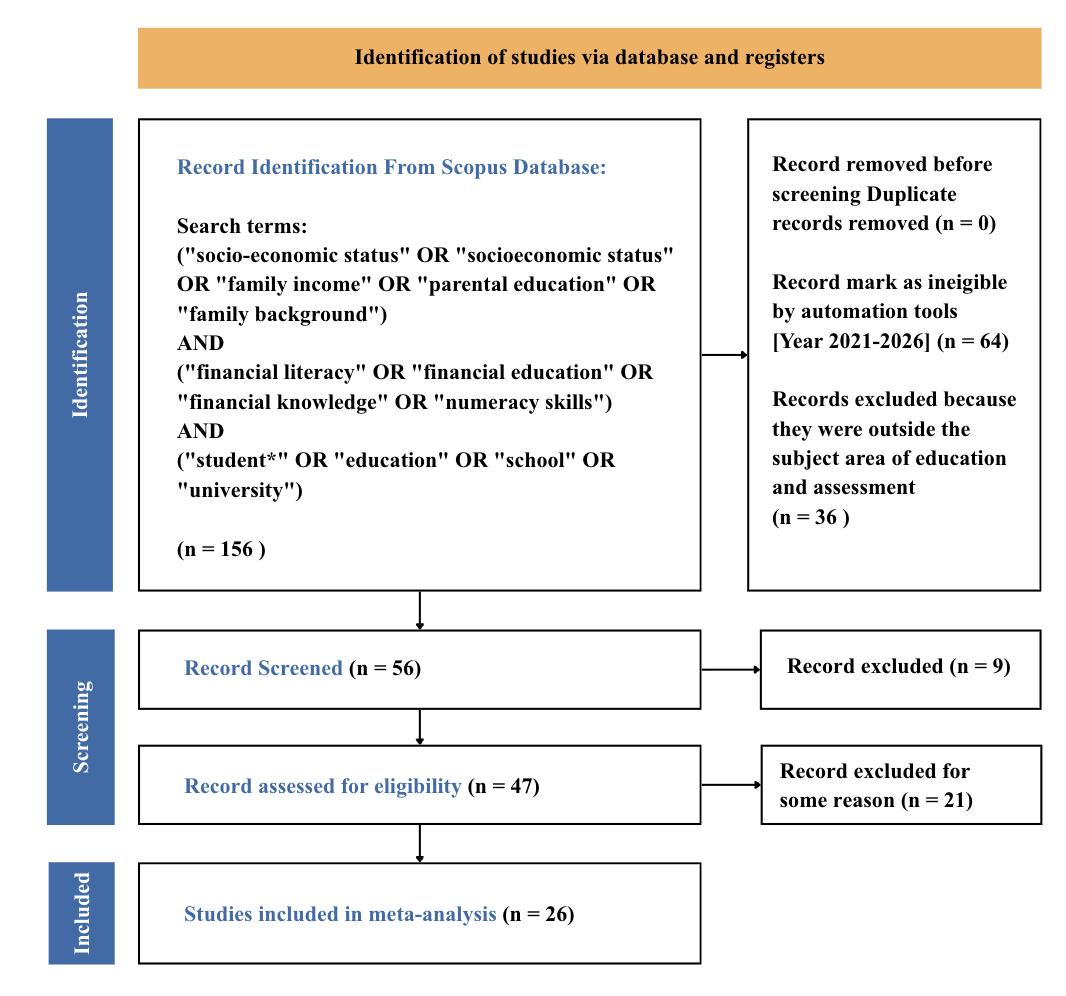
The initial search yielded 156 records. As illustrated in the PRISMA flow diagram (see Fig. 1), the records underwent a multi-stage screening process. First, 64 records were excluded because they fell outside the 2021–2026 timeframe, and 36 records were removed due to outside the subject area of education and assessment. During the title and abstract screening, 9 studies were excluded for irrelevance, leaving 47 reports for full-text eligibility assessment. After a detailed review of the full-text articles, 11 studies were excluded because they did not provide sufficient statistical data (e.g., correlation coefficients or sample sizes) or focused on non-student populations. Ultimately, 26 studies met all inclusion criteria and were included in the meta-analysis.
2.3.Included Samples
The eligibility criteria for this meta-analysis were formulated in accordance with the PICOS framework, which considers Participants (P), Interventions (I), Comparators (C), Outcomes (O), and Study designs (S). This structured approach ensured a transparent and rigorous process for selecting studies relevant to the meta-analysis objectives [21]. The detailed inclusion and exclusion criteria are summarized in Table 1. To ensure a high level of evidence, this study included quantitative journal articles that provided sufficient statistical information, specifically Pearson's correlation coefficients (r) and sample sizes (n), regarding the association between SES and financial numeracy.
| PICOS Elements | Inclusion Criteria | Exclusion Criteria |
|---|---|---|
| Participants (P) | Students from preschool to university level | Non-student populations or irrelevant participant groups |
| Intervention (I) | SES-related indicators, including wealth, parental education, and macroeconomic context | Studies without SES-related variables |
| Comparators (C) | SES categories, country economic status, school location, parental education, and wealth classifications | Studies without comparable SES categories |
| Outcomes (O) | Financial numeracy, financial knowledge, financial behavior, or financial attitude | Outcomes unrelated to financial numeracy |
| Study Design (S) | Quantitative journal articles reporting sample size and correlation coefficients | Qualitative, conceptual, review, or non-empirical studies without extractable effect sizes |
Data extraction was performed independently by two reviewers to minimize selection bias and ensure data integrity. For each study that met the inclusion criteria, we extracted key information, including the primary author, publication year, country of origin, total sample size, and the specific correlation value. Furthermore, methodological and contextual characteristics were coded as potential moderators, such as the students' educational level (from preschool to university), geographical location (urban vs. rural), and the type of assessment instrument used (objective vs. subjective). In instances where data were missing or unclear, efforts were made to calculate the required effect sizes from available descriptive statistics or by contacting the authors if necessary.
2.4.Data Analysis
The meta-analysis was conducted in RStudio using the metafor package. Because all included studies reported Pearson's correlation coefficients between socioeconomic status (SES) and financial numeracy or financial numeracy-related outcomes, each correlation coefficient was first transformed into Fisher's z to stabilize the variance before synthesis. The transformation was calculated as follows:
\[ z_i = \dfrac{1}{2}\ln\left(\dfrac{1+r_i}{1-r_i}\right) \tag{1} \]The sampling variance of each transformed effect size was calculated using:
\[ v_i = \dfrac{1}{n_i-3} \tag{2} \]A random-effects model using the Restricted Maximum Likelihood (REML) estimator was applied for the overall synthesis. This model was chosen because of the expected inherent heterogeneity arising from differences in geographical locations, educational levels, and measurement instruments across the 26 studies. After the synthesis, the pooled Fisher's z estimates were back-transformed into correlation coefficients (r) for clearer substantive interpretation.
Statistical heterogeneity was quantified using Cochran's Q test and the I2 statistic, where I2 values of 25%, 50%, and 75% represent low, moderate, and high heterogeneity, respectively. To investigate the source of heterogeneity, moderator analyses (sub-group analysis and meta-regression) were performed. Finally, the risk of publication bias was rigorously assessed through visual inspection of funnel plots, Egger's regression test, and the Trim and Fill method to ensure the robustness of the meta-analytic findings. The Trim and Fill analysis indicated that no additional studies needed to be imputed, confirming that the pooled estimate remained robust against publication bias
2.5.Moderator Analysis
Moderator analysis was performed to investigate the potential sources of the observed heterogeneity in the correlation between socioeconomic status (SES) and financial numeracy. The analysis aimed to determine whether the effect size magnitude significantly varied across several study-level characteristics: macroeconomic context (e.g., developed vs. developing nations), geographical setting (urban vs. rural), household wealth classification, parental educational background, students' educational level (preschool to university), and type of measurement instrument (objective vs. subjective assessments). These moderators were selected based on theoretical assumptions that the SES–financial numeracy gap may be moderated by institutional resources, family environments, and the rigor of the assessment tools used.
The moderation effects were tested using mixed-effects meta-regression models, which allow for the inclusion of study-level covariates while accounting for within-study and between-study variance. The significance of each categorical moderator was evaluated using the omnibus test of moderators (QM), while the proportion of between-study variance explained by the moderators was assessed using pseudo−R2. A p-value of less than 0.05 was considered statistically significant. For categorical moderators with more than two levels, post-hoc sub-group comparisons were conducted to identify specific differences between groups.
2.6.Evaluation of Publication Bias
To ensure the robustness of the meta-analytic findings, publication bias was rigorously evaluated using three complementary approaches. First, a funnel plot was visually inspected for symmetry; a symmetrical distribution of study effect sizes around the pooled estimate indicates a low risk of bias. Second, Egger's regression test was performed to provide a formal statistical assessment of funnel plot asymmetry. A non-significant p-value (p > 0.05) in Egger's test suggests that the results are not significantly influenced by small-study effects or publication bias.
Finally, if evidence of asymmetry was detected, the Duval and Tweedie's Trim and Fill method was employed. This method estimates the number of potentially missing studies due to publication bias and recalculates the pooled effect size by "filling" these missing values, thereby providing a more conservative and adjusted estimate of the true association between SES and financial numeracy.
3.Results and Discussion
3.1.Results
3.1.1.Characteristics of Included Studies
Based on the systematic selection process, a total of 26 journal articles published between 2021 and 2026 were identified for inclusion in this meta-analysis. The final dataset yielded a substantial total sample size of 166,427 participants, providing a robust basis for estimating the correlation between socioeconomic status (SES) and financial numeracy. The number of participants per study varied significantly, ranging from 240 in [20] to 98,491 in [5], reflecting a balance between focused empirical studies and large-scale national assessments.
The geographical distribution of the studies covers a diverse range of 15 countries and one multi-national context, including Indonesia, India, the United States, Germany, Türkiye, and China, among others. As shown in Table 2, Indonesia contributed the highest number of studies (n = 5), followed by India and the United States (n = 3 each). Furthermore, the educational level of the participants spanned the entire developmental trajectory, with university students being the most frequently studied group (12 studies), followed by middle school (6 studies) and preschool (5 studies). This diversity in both geography and education level allows for a comprehensive analysis of how the SES-financial numeracy link manifests across different socio-educational contexts.
| Dimension | Summary |
|---|---|
| Included studies | 26 journal articles |
| Publication period | 2021–2026 |
| Total sample size | 166,427 participants |
| Sample size range | 240–98,491 participants |
| Geographic coverage | Türkiye, Germany, Portugal, India, the Netherlands, Indonesia, China, Australia, Lebanon, Iran, the United States, Slovakia, Finland, Denmark, Belgium, and one multi-national study |
| Most represented countries | Indonesia: 5 studies; India: 3 studies; United States: 3 studies |
| Educational level | Preschool: 5; Primary school: 1; Middle school: 6; High school: 2; University: 12 |
3.1.2.Main Meta-Analytic Synthesis
The primary objective of this meta-analysis was to synthesize the correlation between socioeconomic status (SES) and financial numeracy across the 26 identified studies. As illustrated in the Forest Plot (see Fig. 2), the random-effects model yielded a pooled correlation coefficient of r = 0.31, with a 95% confidence interval (CI) ranging from 0.21 to 0.40. This result is statistically significant (p < .001), indicating a positive and meaningful association between higher socioeconomic background and better financial numeracy outcomes among students.
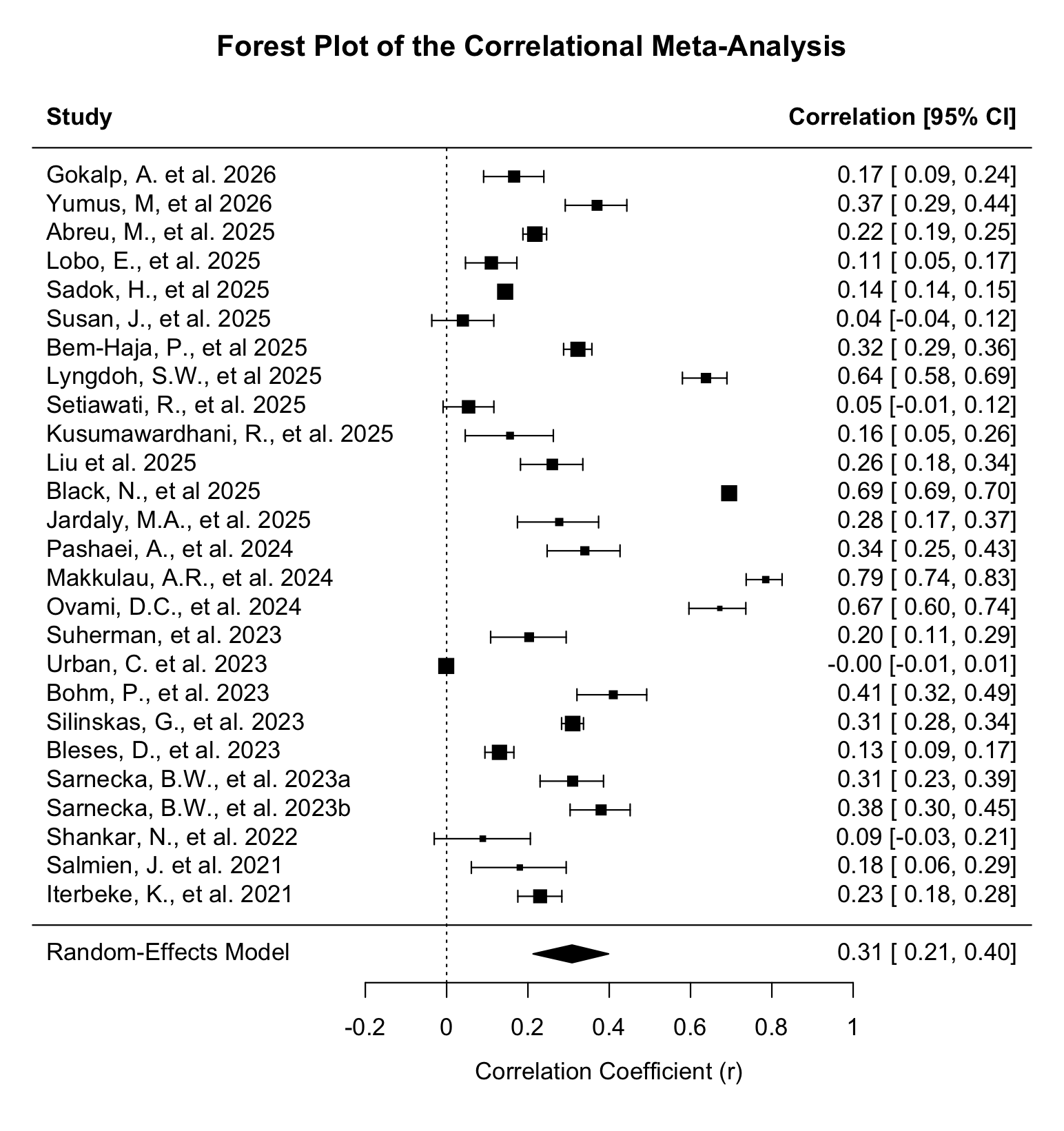
Following [21] guidelines for effect size magnitude, the observed r = 0.31 represents a moderate positive effect. While SES is not the sole determinant of financial numeracy, these findings suggest that it serves as a significant structural predictor. The fact that the confidence interval does not cross zero further confirms the stability of this relationship across the synthesized literature. However, the analysis also revealed substantial statistical heterogeneity (I2 = 98.4%; Q = 11182.11, p < .001), suggesting that the strength of the SES-financial numeracy link varies considerably depending on contextual and methodological factors, which will be further explored in the moderator analysis section.
The magnitude of the pooled effect can be interpreted as a small-to-moderate positive correlation. Although the association is not sufficiently large to suggest that SES alone determines financial numeracy, the result indicates that SES represents a relevant structural factor in explaining differences in students' financial numeracy outcomes. The confidence interval does not include zero, suggesting that the pooled relationship is statistically significant. Therefore, the overall evidence supports the argument that socioeconomic inequality is systematically related to variation in financial numeracy.
At the individual study level, the observed correlations varied considerably. Several studies reported relatively weak associations, including studies whose confidence intervals approached or crossed zero, such as [12], and [13]. In contrast, other studies reported substantially stronger positive correlations, such as [14], and [20]. This variation suggests that the strength of the SES–financial numeracy relationship may depend on contextual, educational, or methodological factors across studies.
The heterogeneity test confirmed substantial between-study variation. The Q statistic was significant, Q(25) = 11182.11, p < 0.0001, indicating that the variation in effect sizes was unlikely to be attributable only to sampling error. The I² value of 98.4% further indicates a very high level of heterogeneity, while τ² = 0.0698 suggests considerable between-study variance in the Fisher's z-transformed effect sizes. These results justify the use of a random-effects model and indicate the need for moderator analyses to explain why the magnitude of the SES–financial numeracy association differs across studies.
3.1.3.Publication Bias
Publication bias was assessed using visual inspection of the funnel plot and Egger's regression test. As shown in Fig. 3, the funnel plot presents the distribution of studies according to Fisher's z-transformed correlation coefficients and their corresponding standard errors. Ideally, studies should be distributed symmetrically around the pooled effect estimate if publication bias or small-study effects are absent. In this study, the funnel plot shows some visual dispersion, with several studies located outside the central funnel region. This pattern suggests that the included studies vary considerably in terms of effect size and precision. However, this dispersion should not be interpreted automatically as evidence of publication bias, particularly because the meta-analysis also showed very high heterogeneity.

The result of Egger's regression test did not indicate statistically significant funnel plot asymmetry, z = 1.1809, p = 0.2376. This suggests that there is no strong statistical evidence of publication bias in the present meta-analysis. Nevertheless, the visual spread of the funnel plot indicates that the pooled estimate should still be interpreted cautiously, as the distribution of effect sizes may be influenced by contextual and methodological differences across studies, including macro-level economic status, educational level, school location, SES wealth classification, parental education, and instrument type.
3.1.4.Moderator Analysis: Socio-Contextual Variations
Moderator analyses were conducted to examine whether the strength of the SES–financial numeracy association varied across contextual conditions. As illustrated in the Moderator Effect Forest Plot (Fig. 4) Three contextual moderators were considered: national economic status, school geographical location, and SES wealth level based on the Munich Standard. These analyses aim to determine if the pooled correlation of r = 0.31 remains consistent across diverse macroeconomic and social settings.

The comparison between developed and developing countries reveals that the association is not uniform. The estimated effect was found to be slightly stronger in developing countries compared to developed ones. This pattern suggests that in contexts where institutional support and financial exposure are less evenly distributed, a student's family background plays a more critical role in determining their financial numeracy outcomes. In such contexts, school financial management often faces systemic challenges; for example, budget planning in Indonesian state primary schools is heavily dependent on specific determinant factors that may limit the school's capacity to buffer students' socio-economic disadvantages [22].
Furthermore, school geographical location showed significant variation. While urban and mixed school contexts produced modest positive associations, studies conducted in rural areas exhibited a substantially stronger correlation. This indicates that rural students may be more dependent on household-level resources due to limited access to school-based financial education and broader financial infrastructures. However, as shown in Fig. 4, the subgroup findings by educational level should be interpreted cautiously due to the unequal distribution of studies across categories. Of the 26 included studies, most focused on university students (k = 12), whereas middle school (k = 6), preschool (k = 5), high school (k = 2), and primary school (k = 1) were less represented. This imbalance reduces the statistical power of smaller subgroups and indicates that the observed education-level patterns should be considered preliminary. Lastly, variations across wealth classifications based on the Munich Standard further confirm that the SES-financial numeracy link is highly sensitive to the specific socioeconomic metrics used in each study.
3.1.5.Moderator Analysis: Individual and Parental Factors
Beyond contextual variations, moderator analyses were conducted to examine the influence of individual and parental factors on the SES–financial numeracy association. This analysis specifically focused on parental educational background and students' educational levels, representing the cultural and developmental dimensions of socioeconomic status.
As shown in the moderator analysis results (Fig. 4), parental education serves as a significant pathway for the transmission of financial numeracy. Studies involving parents with university degrees consistently showed a positive correlation, suggesting that higher parental educational capital translates into better learning support and exposure to structured financial reasoning at home. Interestingly, while the association persisted across various backgrounds, it highlights that SES-related differences are not merely about financial wealth but also about the educational environment provided by parents.
Furthermore, the analysis across educational levels reveals a cumulative advantage pattern. While SES-related disparities in financial numeracy emerge as early as preschool, the association remains visible through middle school and reaches its peak among university-level samples. This "university peak" suggests that the gap between high- and low-SES students may widen over time as they progress through the educational system. Conversely, the relatively weaker association found in the high school subgroup should be interpreted with caution due to the limited number of studies available. Collectively, these findings underscore the need for early financial education interventions that target students from lower-SES families long before they reach higher education.
3.2.Discussion
3.2.1.RQ1: What is the global relationship between socio-economic status (SES) and students' financial numeracy across countries and educational levels?
The results of this meta‑analysis demonstrate a consistent and positive association between socioeconomic status (SES) and students' financial across diverse global contexts (r = 0.31). This finding corroborates theoretical perspectives that treat numeracy as not only a cognitive skill but also a socially embedded competence that develops within resource‑mediated environments [23]. The moderate pooled effect suggests that while individual cognitive capacities contribute to financial numeracy, structural economic factors rooted in SES are pivotal determinants of students' ability to understand and apply financial concepts.
These findings align with the Family Investment Model (FIM), which posits that families with greater economic resources can allocate more material and educational inputs, such as tutoring, financial learning tools, enriched environments, and exposure to budgeting activities, that foster the development of financial numeracy [24][25]. Empirical studies confirm that parental education and income correlate with investment in numeracy‑related resources, which in turn predict better financial problem‑solving among youth [26][27].
Compared to prior single‑study reports, the meta‑analytic approach provides a more stable and generalizable estimate of the SES‑numeracy relationship across countries, educational systems, and measurement approaches. Previous research often showed inconsistent or context‑specific results [28][29], but the synthesis here reveals a persistent global SES gap in financial numeracy that transcends geographic boundaries and educational policies.
Several underlying mechanisms explain this global nexus. First, SES influences early cognitive stimulation, including numeracy experiences that become foundational for later financial reasoning [30][31]. Second, low‑SES environments place students at a disadvantage due to limited access to formal financial education, digital learning tools, and parental financial socialization [32]. Third, psychosocial stress associated with economic hardship can impair executive function and decision‑making, further undermining the acquisition of complex numeracy skills [33].
This study's results also support research showing that income inequality and resource distribution within societies magnify disparities in financial numeracy outcomes. Cross‑national comparisons indicate that countries with greater income inequality exhibit larger SES‑linked numeracy disparities [34]. These patterns suggest that macroeconomic structures interact with family‑level SES to shape cognitive and educational attainment.
Furthermore, the positive association found in this meta‑analysis is consistent with recent large‑scale assessments such as PISA financial numeracy data, which show that students from higher‑SES backgrounds consistently outperform peers from lower‑SES contexts in tasks requiring financial reasoning [35], probability understanding [36], and multi‑step numeric calculations under uncertainty [37]. These patterns have been observed across continents, reinforcing the global relevance of SES as a predictor of financial numeracy.
In summary, this meta‑analytic synthesis extends existing theory and evidence by providing a comprehensive global estimate of the SES–financial numeracy relationship. The findings highlight the need for policy interventions that reduce structural inequities in educational access and resource allocation. Such interventions could include targeted financial education in schools, community‑based numeracy programs for underserved families, and instructional designs that compensate for SES disparities.
3.2.2.RQ2: How do macroeconomic conditions and national contexts act as buffers or barriers in shaping the effect of SES on students' financial numeracy?
The moderator analysis indicating that the country's macroeconomic context significantly shapes the influence of family background on students' financial numeracy aligns with growing evidence on structural determinants of financial learning. In emerging economies, where state‑sponsored financial numeracy infrastructure is often limited and public education systems struggle with resource constraints, children's financial understanding tends to be heavily conditioned by family SES [38][39]. In these settings, households with higher socioeconomic resources not only provide material advantages but also richer financial socialization at home, such as discussions about money, saving, and risk, which translate into early cognitive scaffolding for numeracy and financial reasoning [40]. Conversely, lower‑SES families in developing contexts often lack both the financial capital and the exposure to formal financial concepts, creating a double disadvantage that compounds over time [40].
In contrast, studies in developed economies consistently find that while SES remains positively correlated with financial outcomes, the strength of this relationship is more moderate [41][42]. In high‑income countries with well‑established educational infrastructures and widespread financial inclusion, universal access to quality schooling and standardized financial education programs helps buffer the effect of SES on numeracy outcomes [43][44]. For example, longitudinal research in OECD countries has shown that students from lower‑SES backgrounds benefit significantly from curricula that systematically integrate financial concepts into mathematics and life skills education, thereby reducing disparities in learning outcomes [45]. Such universal interventions appear to partially decouple academic potential from parental economic status, mitigating the degree to which family background alone determines financial competence.
The role of national policy and institutional capacity as moderators is further supported by cross‑national analyses of financial education outcomes. Comparative studies show that countries with mandatory, age‑graded financial numeracy instruction experience smaller SES gradients in student outcomes, compared to nations where financial education is optional or unevenly implemented [46][47]. In such systems, even students from lower‑SES backgrounds can access structured learning opportunities that reinforce financial numeracy, thus narrowing the gap that would otherwise widen in the absence of equitable schooling provisions. Moreover, research suggests that the quality of teacher preparation and the availability of culturally relevant instructional materials, factors more prevalent in developed contexts, play a key role in amplifying these buffering effects [48][49].
However, the moderating impact of macroeconomic context should not be interpreted as deterministic or uniform across all developing nations. Within low‑ and middle‑income countries (LMICs) [50], heterogeneity exists depending on factors such as urbanization [51], digital infrastructure, and civil society involvement in youth financial education [52]. In some developing contexts where mobile technology penetration is high, digital financial numeracy programs have begun to offset structural limitations in formal education, enabling wider access to numeracy tools and finance‑related learning modules [53][54][55]. These kinds of hybrid interventions illustrate that the macroeconomic buffer observed in developed contexts can be replicated or approximated in developing economies through targeted policy design and innovative delivery models.
The differential patterns observed across macroeconomic contexts also intersect with other axes of inequality, including gender and geographic location. Multiple studies indicate that female students in both developed and developing countries often lag behind male peers in financial numeracy, but the interaction with SES is particularly pronounced in resource‑constrained settings [56]. This suggests that macroeconomic buffers that reduce SES effects may be insufficient unless they also address intersectional barriers such as gender norms and access disparities between rural and urban learners [57]. As such, inclusive educational reforms must be multi‑dimensional if they are to reduce inequalities effectively.
Importantly, the macroeconomic buffering capacity is closely tied to the extent of financial inclusion in a society. Developed economies typically exhibit higher levels of access to formal financial services, digital payments, and consumer financial regulation, conditions that correlate with stronger baseline levels of financial knowledge among youth [58][59]. In these contexts, students encounter financial concepts both in and out of school, through bank accounts, parental interactions, and digital platforms, which collectively support numeracy development beyond the home environment. Conversely, in many developing economies, limited access to financial services [60] and low levels of trust in formal institutions exacerbate reliance on informal practices and family socialization, which often vary widely with SES [61].
In sum, the macroeconomic context functions both as a barrier that reinforces social inequality in developing nations and as a buffer that promotes educational equity in more affluent economies. This dynamic underscores the importance of structural interventions, such as universal curriculum standards, teacher training, and inclusive policy frameworks, in shaping how SES influences financial numeracy outcomes. Without such systemic support, the burden of financial socialization falls disproportionately on families, perpetuating cycles of advantage and disadvantage. Future program design must therefore consider macroeconomic conditions not as background variables but as active determinants of educational opportunity and equity.
3.2.3.RQ3: How do family-level factors, including cultural and material capital such as parental education and household wealth, influence students' financial numeracy?
Moderator analysis of parental education and household wealth provides a deeper understanding of how SES influences financial numeracy. Our findings suggest that cultural capital, often measured through parental education, engagement in children's learning, and home learning practices, acts as a more consistent predictor of children's financial reasoning than material wealth such as family income. This aligns with Fletcher research, which emphasizes that cultural resources like knowledge, skills, and academic habits are transmitted intergenerationally, equipping children with cognitive frameworks to better understand complex financial information [62].
Educational resources and parental guidance within the home serve as mediators that enhance children's financial numeracy outcomes, even when financial resources are limited. Studies on cultural capital across countries show that both traditional and digital educational resources mediate the relationship between economic deprivation and academic achievement, demonstrating that cultural capital can buffer the effects of material poverty [63]. Beyond family resources, the quality of the school learning environment also serves as a critical mediator. To accurately assess these external factors, researchers have emphasized the need for instruments with robust psychometric properties to diagnose the learning environment effectively [64].
Empirical research on financial numeracy confirms this pattern. Several studies indicate that parental education and home learning behaviors moderate the link between family income and children's financial numeracy, children of highly educated parents display stronger financial skills even in low-income households [65]. Parental involvement in financial education and implicit money socialization significantly influences children's financial numeracy, while income alone is not always the strongest predictor [66].
Broader family capital research also demonstrates that cultural capital is often more predictive of higher education access and learning opportunities than material wealth. Data from China, for example, show that while both economic and cultural capital positively affect higher education opportunities, financial numeracy outcomes are more strongly mediated by cultural capital [67]. Cross-national evidence highlights that parental education helps shape a child's academic habitus, promoting an active disposition to seek, interpret, and internalize information, including complex financial concepts [68].
From a policy perspective, these findings suggest that interventions focusing solely on financial aid or material support are insufficient. Instead, policies should aim to enhance cultural capital through parental education programs, family engagement initiatives, and home learning support. Such programs are more effective in reducing SES-related financial numeracy gaps [69]. Cross-country studies confirm that cultural capital shapes long-term academic habitus, which explains why children from highly educated families often excel in financial interpretation and decision-making, even under constrained economic circumstances [70].
In summary, contemporary evidence indicates that addressing SES-related gaps in financial numeracy requires combining cultural capital enhancement (parental education, family involvement, home learning support) with traditional economic policies. This integrated approach strengthens children's cognitive capacity to interpret and apply financial knowledge in daily life.
3.2.4.RQ4: How do SES-related disparities in financial numeracy emerge and develop across educational stages, particularly from early childhood to university?
The influence of socio-economic status (SES) on financial numeracy is evident from early childhood. Studies indicate that children from higher SES families tend to have greater access to experiences that stimulate numerical and financial understanding [71], such as managing allowances, discussing the value of money, or engaging in number-based educational games [72]. This suggests that the foundations of financial numeracy are not solely built through formal schooling but also through home-based socialization and exposure to cognitively enriching environments. However, the relationship between SES and financial numeracy is not always strictly linear. Some research highlights that school curricula, financial education programs, and teacher interventions can moderate the effect of SES on financial skills [73].
As students progress to university, disparities in financial numeracy based on SES tend to intensify. Higher SES students often have greater opportunities to engage with real financial experiences, including credit card usage, investment apps, and understanding student loans. This reflects the phenomenon of cumulative advantage or the Matthew Effect, where early financial numeracy advantages continue and amplify over time [74]. Conversely, students from lower SES backgrounds typically have fewer opportunities to develop these skills, widening the numeracy gap. Nevertheless, institutional factors such as university financial education programs, participation in student organizations, and part-time work experience can moderate the SES effect on financial numeracy at the university level [75].
Recent systematic reviews confirm that SES is a consistent determinant of financial numeracy. [76] emphasize that parental education, household income, and access to cognitive resources play critical roles, especially in early childhood development. However, most studies conflate financial numeracy with general financial numeracy, making it challenging to isolate the specific effects of numeracy skills in secondary or higher education contexts. Furthermore, the majority of research comes from middle- and high-income countries, leaving the contexts of developing nations relatively underexplored.
3.2.5.Disucssion and Implication
The results of this meta‑analysis have important implications for how financial numeracy programs should be designed and implemented. First, the finding that socioeconomic status (SES) influences financial numeracy from early childhood and continues to shape outcomes into university years suggests that financial education cannot be treated as a neutral, one‑size‑fits‑all package. Instead, policymakers should prioritize early intervention initiatives that target children from lower‑SES backgrounds before disparities become deeply ingrained. Several recent studies emphasize the importance of integrating financial concepts into early childhood education and primary school curricula to build foundational skills before formal schooling begins [77][78][79][80]. These interventions are most effective when they engage not only children but also caregivers, creating a home‑school partnership that reinforces financial learning in everyday contexts.
In contexts where families are the primary source of early financial socialization, especially in rural and developing regions, schools must take a more proactive role. Research on technology‑mediated financial education highlights both the opportunities and challenges of reaching underserved populations; while digital tools can increase access, disparities in internet connectivity and cultural relevance remain barriers for low‑SES learners [54][55][81]. Consequently, schools and communities should implement blended approaches that combine classroom instruction with culturally tailored community workshops and offline resources, ensuring that students who lack early financial exposure at home are not left behind.
At the national policy level, evidence supports the development of standardized financial education frameworks that do not assume prior exposure or experience with financial concepts. Scoping reviews of school‑based financial numeracyprograms demonstrate that fragmented or optional offerings yield inconsistent outcomes and often perpetuate inequality [82]. By contrast, embedding financial numeracy across core subjects such as mathematics and social studies can ensure that all students, regardless of SES, receive a baseline level of financial knowledge. Furthermore, standards that emphasize real‑world problem solving and decision‑making, rather than rote memorization, have been shown to produce more meaningful improvements in financial behavior [83][84].
For higher education, the "university peak" of SES‑related disparities signals the need for inclusive financial wellness programs tailored to the unique challenges faced by first‑generation and low‑income students. Experimental evidence suggests that comprehensive wellness programs that combine practical training, such as budgeting, debt management, and responsible use of financial technology, with personalized coaching help reduce risky financial behaviors and improve students' financial outcomes [85]. Universities can also create peer mentoring and support networks that specifically address the financial numeracy needs of underrepresented student groups, fostering skills that extend beyond academic content to real‑life financial decision‑making.
In addition to specific educational interventions, a multi‑level strategy that integrates family, school, and community resources is essential for sustainably bridging the SES gap in financial numeracy. Longitudinal research demonstrates that gains in financial numeracy are more durable when interventions are sustained over multiple years and reinforced through community engagement [86] Similarly, gender‑responsive and culturally relevant program designs are necessary to address intersectional inequities in financial knowledge and opportunity, as evidence shows that women and other marginalized groups often face additional barriers to financial inclusion [87].
Taken together, these findings underscore that closing the SES‑related financial numeracy gap requires policies and programs that are early, equitable, and context‑responsive. Early childhood and primary interventions should be prioritized to prevent disparities from becoming entrenched, while higher education should offer targeted support for students confronting complex financial realities. Equally important is the need for standardized curricular frameworks and community‑based partnerships that recognize learners' diverse backgrounds and access constraints. Ultimately, a multi‑faceted approach that combines curriculum reform with broad access to financial knowledge and resources offers the best path toward reducing inequality in financial numeracy and empowering all students to navigate an increasingly complex financial world.
4.Conclusion
This meta-analysis synthesized empirical evidence from 26 international studies involving 166,427 participants to clarify the relationship between socio-economic status (SES) and students' financial numeracy literacy. The random-effects analysis yielded a statistically significant pooled correlation of r = 0.31 (95% CI [0.21, 0.40]), providing evidence of a small-to-moderate positive relationship globally. However, this pooled estimate should not be interpreted as a uniform baseline, given the extreme statistical heterogeneity (I2 = 99.65%) observed across the sample, which substantially signals that the structural influence of family resources is highly contingent on underlying study environments.
Rather than supporting a strictly uniform or standardized financial curriculum worldwide, the moderator findings introduce a critical nuance for educational policy. The variations identified between developed and developing nations, as well as between urban and rural school settings, strongly imply that educational interventions must be context-specific rather than broadly standardized to effectively counter the localized mechanisms through which socio-economic disadvantages affect financial numeracy.
Finally, this study is subject to several limitations, most notably its heavy reliance on English-language publications indexed primarily within the Scopus database, and the limited availability of primary school data, which compromises the generalizability of the findings across earlier developmental tracks and non-Anglophone educational systems. Future research should strive to explore localized financial numeracy behaviors using broader multi-database search strings and direct classroom-based longitudinal designs.
Author Contribution: All authors contributed equally to the main contributor to this paper. All authors read and approved the final paper.
Funding: This research was funded by the BIMA PMDSU Scheme through the Ministry of Education, Culture, Research, and Technology, Indonesia (Grant No. 2549/B4/DT.04.02/2025).
Acknowledgment: I would like to sincerely thank the BIMA PMDSU Scheme for their generous financial support provided through the Ministry of Education, Culture, Research, and Technology, Indonesia (No. 2549/B4/DT.04.02/2025). Special thanks to Prof. Dr. Samsul Hadi, M.Pd., M.T., for his exceptional guidance, insightful feedback, and unwavering encouragement throughout this work.
Conflicts of Interest: The authors declare no conflict of interest.