
Vol. 3, No. 1, 2025, pp. 1-13
ISSN 3030-9174
https://e-journal.ptti.info/index.php/ijase
Mapping Educational Service Quality Research: A Bibliometric and Science Mapping Analysis of Research Trends and Thematic Evolution (2011–2026)
b MS in Organizational Leadership, Arizona State University, USA
c Department of Applied and Computational Mathematics, University of Washington, USA
d Department of Educational Psychology, Texas A&M University, USA
1 reskynuralisa.2022@student.uny.ac.id; 2 dwimahardiyati28654@gmail.com; 3 laman18@uw.ed; 4 indahhamid@tamu.edu
* Corresponding Author
Article history Received May 04, 2025
Revised April 11, 2025
Accepted June 26, 2025
Bibliometric Analysis;
Science Mapping;
Student Satisfaction;
SERVQUAL;
Higher Education
This study aims to analyze publication trends, thematic structures, collaboration patterns, and emerging research directions in educational service quality studies indexed in the Scopus database between 2011 and 2026. A total of 70 journal articles were selected through a PRISMA-based screening process from an initial dataset of 193 documents. The analysis employed bibliometric and science mapping techniques, including publication trend analysis, co-authorship analysis, bibliographic coupling, and keyword co-occurrence analysis. Bibliometrix (R-package) was used for descriptive bibliometric analysis, while VOSviewer was utilized to visualize thematic relationships and research networks. The findings indicate a significant increase in publication output after 2019, reflecting growing academic interest in educational service quality evaluation. Research in this field is predominantly concentrated within social sciences and management disciplines, with SERVQUAL, student satisfaction, higher education, and service quality emerging as the most dominant themes. The keyword evolution analysis demonstrates a transition from descriptive and perception-based evaluation approaches toward more outcome-oriented research focusing on institutional performance and student experience. The collaboration analysis reveals relatively fragmented research networks among authors and institutions, indicating opportunities for stronger interdisciplinary and international collaboration. The existing literature remains heavily dependent on traditional survey-based methodologies, while advanced analytical approaches such as learning analytics, machine learning, predictive modelling, and intelligent decision support systems remain underexplored within educational service quality research. This study contributes to the literature by providing a comprehensive bibliometric overview of the intellectual structure and thematic evolution of educational service quality research. The findings offer insights for researchers, educational institutions, and policymakers in developing more data-driven, interdisciplinary, and technology-oriented approaches for evaluating and improving educational service quality.

1.Introduction
The quality of services in educational institutions has become a critical issue in recent decades, particularly in the context of increasing competition [1][2][3], globalization [4], and the growing demand for accountability in education systems [5]. Educational institutions are no longer viewed solely as providers of knowledge but also as service organizations that must meet the expectations of their stakeholders [6], especially students as primary users. Consequently, the concept of educational service quality has gained significant attention, as it directly influences student satisfaction, institutional performance, and overall educational effectiveness. Previous studies have emphasized that service quality plays a crucial role in shaping user perceptions and determining the success of educational institutions, particularly in higher education contexts [7]. However, despite the growing number of studies, the research landscape remains fragmented, with variations in conceptual frameworks, measurement approaches, and research focus across different disciplines and regions.
A major challenge in this field lies in the lack of a unified and comprehensive understanding of how educational service quality has evolved over time. Existing studies have predominantly focused on empirical investigations using survey-based methods, often relying on traditional models such as SERVQUAL to assess service quality and satisfaction [8][9]. While these approaches have contributed valuable insights, they tend to emphasize perception-based evaluation and may not fully capture the complexity of service systems in modern educational environments. Furthermore, many studies are conducted within specific institutional or regional contexts, limiting the generalizability of their findings. The absence of a systematic and large-scale synthesis of the literature makes it difficult to identify key research trends, dominant themes [10][11], and existing gaps, thereby hindering the development of more advanced and integrated research frameworks [12][13][14].
Recent studies on educational service quality have primarily focused on empirical evaluations of student satisfaction, institutional performance, and the application of service quality frameworks such as SERVQUAL in higher education contexts [15]. While these studies provide valuable insights into service evaluation practices, most remain limited to specific institutional settings and rely heavily on perception-based survey methods [16][17][18]. In addition, existing review studies in this area are generally narrative or systematic in nature and do not comprehensively map the intellectual structure, collaboration networks, thematic evolution, and emerging research trends within the field. As a result, there is still limited understanding of how educational service quality research has evolved globally, which themes dominate the literature, and what methodological gaps remain insufficiently explored.
Bibliometric analysis has been widely recognized as an effective approach for quantitatively mapping scientific knowledge structures, identifying influential publications, collaboration patterns, and thematic developments within a research domain. Previous bibliometric studies in education and service-related research have demonstrated the usefulness of science mapping techniques in revealing research trends and intellectual structures. However, bibliometric investigations specifically examining educational service quality remain scarce and fragmented. Existing studies tend to focus only on limited aspects such as student satisfaction or service management without integrating publication trends, co-authorship networks, bibliographic coupling, and keyword evolution into a unified analytical framework. Therefore, a comprehensive bibliometric and science mapping study is necessary to provide a broader and more systematic understanding of the development of educational service quality research.
The novelty of this study lies in its integrated bibliometric approach that combines descriptive performance analysis with science mapping techniques to examine the evolution of educational service quality research indexed in the Scopus database from 2011 to 2026. Unlike previous studies that primarily emphasized descriptive reviews or single-dimensional analyses, this study provides a comprehensive examination of publication trends, collaboration networks, thematic structures, bibliographic coupling, and temporal keyword evolution. In addition, this study identifies methodological gaps within the literature, particularly the limited integration of advanced analytical approaches such as data-driven modelling, decision support systems, and computational evaluation methods in educational service quality research.
Based on these considerations, this study aims to conduct a comprehensive bibliometric and science mapping analysis of research on educational service quality using data from the Scopus database. The analysis focuses on identifying publication trends, key contributors, collaboration patterns, subject area distribution, and thematic structures through keyword co-occurrence and network visualization. By applying advanced bibliometric techniques, this study seeks to provide a holistic understanding of the development and current state of research in this field.
The contribution of this research is to provide a systematic and data-driven mapping of educational service quality research by integrating bibliometric analysis with science mapping techniques, thereby identifying research trends, intellectual structures, and emerging themes. In addition, this study highlights existing research gaps, particularly the limited use of advanced analytical and modelling approaches, and proposes future research directions to enhance the methodological rigor and practical relevance of studies in this field. The findings of this research are expected to serve as a reference for researchers, policymakers, and practitioners in developing more effective strategies for evaluating and improving service quality in educational institutions.
2.Method
This study employed a bibliometric and science mapping approach to systematically analyse the development and intellectual structure of educational service quality research. Bibliometric analysis is a quantitative method used to evaluate scientific publications through the examination of publication patterns, authorship structures, collaboration networks, and thematic relationships within a specific research field. The purpose of this approach is to identify research trends, influential contributors, thematic evolution, and emerging research directions in educational service quality studies.
The purpose of this method is to identify the intellectual structure, research evolution, and emerging trends within the field. In this study, several bibliometric techniques are applied, including: publication trend analysis, co-authorship analysis, citation and co-citation analysis, bibliographic coupling and keyword co-occurrence analysis. To visualize and analyze the bibliometric networks, this study utilizes VOSviewer and Bibliometrix (R-package), which are widely used tools for mapping scientific knowledge structures.
2.1.Data Source
The data for this study were retrieved from the Scopus database, which is recognized as one of the largest and most comprehensive abstract and citation databases of peer-reviewed literature. The data collection was conducted on March 1, 2026, using a structured search strategy based on Boolean operators. The search query focused on publications related to educational service quality and its evaluation context. All retrieved documents were exported in CSV/RIS format for further bibliometric analysis. To ensure data accuracy and relevance, all records were carefully screened by reviewing titles, abstracts, and keywords. Any irrelevant or duplicate documents were removed during the data cleaning process.
2.2.Eligibility Criteria
To ensure the quality and relevance of the dataset, the following inclusion criteria were applied:
1. Document type : journal articles
2. Language : English
3. Source : Scopus-indexed publications
4. Time span : 2011-2026
5. Keywords must relate to : "educational service quality", "service quality in education", "academic service quality"
The search strategy used the following Boolean query: (TITLE-ABS-KEY("educational service quality" OR "service quality in education" OR "academic service quality")) AND (TITLE-ABS-KEY(evaluation OR measurement OR assessment)) AND (LIMIT-TO(DOCTYPE, "ar")) AND (LIMIT-TO(LANGUAGE, "English")).
Exclusion criteria included:
1. Conference papers
2. Irrelevant topics outside the education context
The research process was conducted in three main stages: study design (Table 1), data preparation (Table 2), and data analysis (Table 3), ensuring a systematic and reproducible bibliometric procedure.
| Stage | Process | Description |
|---|---|---|
| Stage 1: Study Design |
Database selection | Scopus database |
| Search field | TITLE-ABS-KEY | |
| Document type | Journal articles | |
| Language | English | |
| Time span | 2000–2025 (adjust if needed) | |
| Keywords | "educational service quality", "service quality in education", "academic service quality", evaluation, measurement, assessment | |
| Boolean query | ("educational service quality" OR "service quality in education" OR "academic service quality") AND (evaluation OR measurement OR assessment) | |
| Initial results | 193 documents |
| Stage | Process | Description |
|---|---|---|
| Stage 2: Data Preparation |
Screening process | Title, abstract, and keyword screening |
| Inclusion criteria | Relevant to educational service quality in education context | |
| Exclusion criteria | Irrelevant topics, conference papers, duplicates | |
| Data cleaning | Removal of duplicates and irrelevant records | |
| Final dataset | 70 articles after screening |
| Stage | Process | Description |
|---|---|---|
| Stage 3: Data Analysis |
Descriptive analysis | Publication trends, authors, countries, institutions |
| Network analysis | Co-authorship, citation, co-citation analysis | |
| Science mapping | Bibliographic coupling, keyword co-occurrence | |
| Software tools | VOSviewer and Bibliometrix (R-package) | |
| Output | Network visualization, cluster mapping, thematic structure |
3.Results and Discussion
3.1.Description of the Retrieved Literature
The distribution of publications indicates a fluctuating but increasing trend over time (Table 4). The highest number of publications was recorded in 2025 with 11 documents (15.71%), followed by 2022 with 8 documents (11.43%). Earlier years such as 2011 and 2015 showed minimal publication output, each contributing only 1 document (1.43%). Overall, the results demonstrate a growing research interest in educational service quality, particularly after 2019.
The analysis of publication trends from 2011 to 2026 reveals a fluctuating yet progressively increasing pattern in research on educational service quality. Based on the Scopus dataset (n = 70), the number of publications remained relatively low during the early period, particularly between 2011 and 2015, where annual outputs ranged from only 1 to 4 documents. This indicates that the topic was still in its initial stage of development, with limited scholarly attention and a relatively narrow research focus. During this phase, studies were sporadic and lacked continuity, suggesting that educational service quality had not yet become a central concern within the broader academic discourse.
| Year | Frequency | Percentage (%) |
|---|---|---|
| 2011 | 1 | 1.43 |
| 2012 | 3 | 4.29 |
| 2013 | 2 | 2.86 |
| 2014 | 4 | 5.71 |
| 2015 | 1 | 1.43 |
| 2016 | 5 | 7.14 |
| 2017 | 2 | 2.86 |
| 2018 | 2 | 2.86 |
| 2019 | 7 | 10.00 |
| 2020 | 5 | 7.14 |
| 2021 | 7 | 10.00 |
| 2022 | 8 | 11.43 |
| 2023 | 5 | 7.14 |
| 2024 | 5 | 7.14 |
| 2025 | 11 | 15.71 |
| 2026 | 2 | 2.86 |
| Total | 70 | 100% |
A gradual increase in publication output began to emerge after 2016, marking a transition toward more consistent research activity. This upward trend became more apparent in 2019, when the number of publications reached 7 documents (10.00%), followed by relatively stable contributions in subsequent years. This period reflects a growth phase in which the topic gained recognition and began to attract sustained academic interest. The increasing number of studies during this stage suggests that researchers started to explore educational service quality more systematically, particularly in relation to evaluation, measurement, and institutional performance.
The most significant expansion in publication output occurred between 2021 and 2025, culminating in a peak in 2025 with 11 documents (15.71%), representing the highest proportion within the dataset. This sharp increase indicates that educational service quality has evolved into a prominent research area, driven by the growing need for quality assurance in educational institutions, the expansion of digital and administrative services, and the increasing emphasis on student satisfaction and service effectiveness. The rising trend during this period also reflects a broader shift toward data-driven approaches and performance-based evaluation systems in education, highlighting the relevance of this topic in contemporary academic and practical contexts [19].
In contrast, the lower number of publications recorded in 2026, with only 2 documents (2.86%), should not be interpreted as a decline in research interest. Instead, this decrease is most likely due to incomplete indexing in the Scopus database for the current year, as not all publications may have been fully recorded at the time of data extraction. Therefore, the overall trajectory still demonstrates a clear upward trend in the development of this research field.
From a broader perspective, the evolution of publication trends suggests that educational service quality has transitioned from an emerging topic into a well-established area of study. The increasing volume of research reflects a growing awareness of the importance of evaluating and improving service quality within educational settings. However, despite this quantitative growth, there remains a need for greater methodological advancement. Many existing studies still rely on descriptive and perception-based approaches, with limited integration of advanced analytical techniques such as modelling, decision support systems, and data-driven evaluation frameworks [20][21][22].
This gap highlights an important opportunity for future research to move beyond conventional approaches and adopt more rigorous and innovative methodologies. By incorporating quantitative modelling, computational analysis, and system-based evaluation frameworks, future studies can contribute to a deeper and more practical understanding of educational service quality. Such developments are essential to enhance both the scientific contribution and the real-world applicability of research in this field, particularly in supporting evidence-based decision making and improving institutional performance in education.
The distribution of authors, countries, and institutional affiliations indicates a relatively dispersed pattern of scholarly contributions within the field of educational service quality (Table 5). At the author level, no single researcher dominates the field, as the most productive authors including Ali, K.A.M., Athanasiadis, A., Bernardo, M., Khalid, S.M., Manna, R., Palumbo, R., and Papadopoulou, V. each contributed only two publications. This suggests a collaborative yet decentralized research structure, where knowledge production is distributed among multiple contributors rather than concentrated within a specific group of scholars.
| Category | Author/Country/Affiliation | Number of Articles (Frequency) |
|---|---|---|
| Author | Ali, K.A.M. | 2 |
| Athanasiadis, A. | 2 | |
| Bernardo, M. | 2 | |
| Khalid, S.M. | 2 | |
| Manna, R. | 2 | |
| Palumbo, R. | 2 | |
| Papadopoulou, V. | 2 | |
| Aqn, K. | 1 | |
| Abdikadyr, Z. | 1 | |
| Adinolfi, P. | 1 | |
| Country | Indonesia | 12 |
| Malaysia | 9 | |
| India | 7 | |
| Iran | 6 | |
| Turkey | 5 | |
| Greece | 3 | |
| Italy | 3 | |
| Russian Federation | 3 | |
| Spain | 3 | |
| Bangladesh | 2 | |
| Affiliation | Universiti Kebangsaan Malaysia | 3 |
| Universitat de Barcelona | 2 | |
| Universidad Andres Bello | 2 | |
| University of Western Macedonia | 2 | |
| Università degli Studi | 2 | |
| Kermanshah University | 2 | |
| Aristotle University of Thessaloniki | 2 | |
| Iran University of Medical Sciences | 2 | |
| Universitas Pendidikan Indonesia | 2 | |
| Health Corporation | 1 |
At the country level, Indonesia emerges as the most productive contributor with 12 publications, followed by Malaysia with 9 and India with 7 publications. Other countries such as Iran (6 publications) and Turkey (5 publications) also show notable contributions, while Greece, Italy, the Russian Federation, and Spain each contributed 3 publications, and Bangladesh contributed 2 publications. This distribution highlights the significant role of developing and emerging countries in advancing research on educational service quality, suggesting that this topic is particularly relevant in contexts where educational systems are undergoing rapid transformation and quality improvement initiatives.
From an institutional perspective, Universiti Kebangsaan Malaysia appears as the most productive affiliation with 3 publications. Several other institutions including Universitat de Barcelona, Universidad Andres Bello, University of Western Macedonia, Università degli Studi, Kermanshah University, Aristotle University of Thessaloniki, Iran University of Medical Sciences, and Universitas Pendidikan Indonesia each contributed 2 publications, indicating a relatively balanced institutional contribution. This pattern suggests that research in this field is not dominated by a single institution but is instead characterized by a broad and international network of universities and research organizations.
Overall, these findings indicate that the research landscape of educational service quality is globally distributed and collaboratively structured. However, the absence of highly dominant authors or institutions also suggests an opportunity for stronger research consolidation, interdisciplinary collaboration, and the development of more integrated research agendas in future studies.
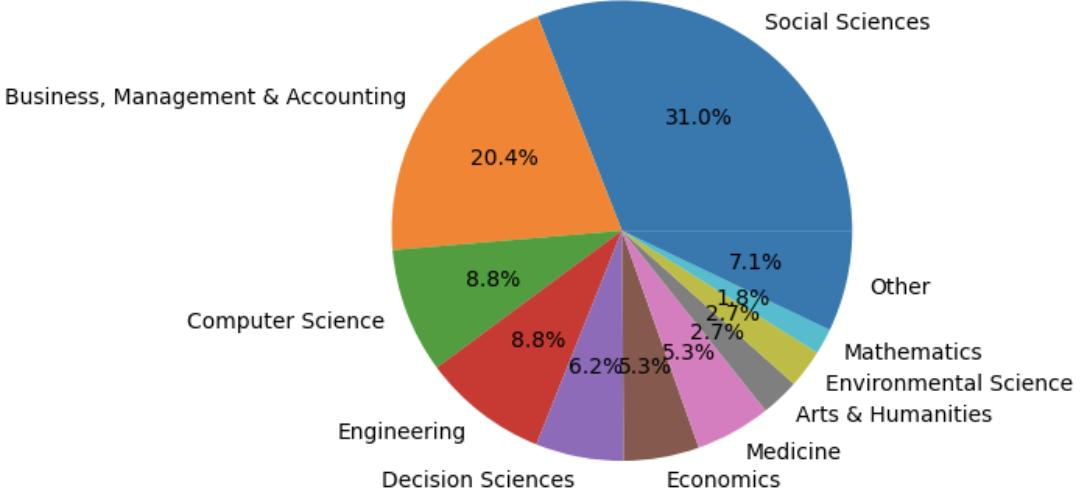
The distribution of documents by subject area (Fig. 1) demonstrates that research on educational service quality is predominantly concentrated within the social sciences, which account for the largest proportion at 31.0%. This is followed by business, management, and accounting, contributing 20.4% of the total publications, indicating a strong connection between educational service quality and organizational performance as well as management practices. In addition, computer science and engineering each contribute 8.8%, reflecting the growing integration of technological and system-based approaches in evaluating educational services. Decision sciences (6.2%), economics, econometrics and finance (5.3%), and medicine (5.3%) also represent significant contributions, suggesting that the topic is increasingly examined through analytical, economic, and interdisciplinary health-related perspectives. Smaller contributions are observed in arts and humanities (2.7%), environmental science (2.7%), and mathematics (1.8%), while other subject areas collectively account for 7.1%. Overall, this distribution indicates that educational service quality is a multidisciplinary research area, with a dominant foundation in social sciences and management, but with increasing expansion into technical and data-driven disciplines such as computer science and engineering. This trend highlights the growing importance of integrating analytical and technological approaches to enhance the evaluation and improvement of educational services.
The observed publication trend indicates a gradual yet significant increase in research on educational service quality, particularly after 2019, reflecting the growing importance of quality assurance and performance evaluation in education systems. This pattern is consistent with previous studies that report a surge in research output in education-related evaluation topics due to increased institutional accountability and global competitiveness in higher education. Similar bibliometric analyses in education and service quality domains have shown that research growth often accelerates in response to policy reforms, digital transformation, and the expansion of higher education systems. The dominance of contributions from countries such as Indonesia, Malaysia, and India further aligns with earlier findings that emerging and developing countries tend to exhibit strong research engagement in education quality improvement due to rapid system expansion and reform initiatives [23][24][25]. Moreover, the relatively balanced distribution of authors and institutions supports prior studies indicating that the field is characterized by collaborative and decentralized knowledge production rather than dominance by a few leading scholars or institutions. However, in contrast to more mature research fields where leading authors or institutions shape the research agenda, the dispersed structure observed in this study suggests that educational service quality research is still evolving and lacks a consolidated intellectual core, thereby reinforcing the need for more integrative and large-scale research efforts.
3.2.Bibliometric Coupling Analysis
The keyword co-occurrence analysis reveals the intellectual structure and thematic relationships within the research field of educational service quality. As shown in the network visualization (Fig. 2), the keywords are grouped into two main clusters, indicating the presence of interconnected but distinct research themes. The first cluster, represented in red, is primarily associated with general educational and research-related terms such as education, article, questionnaire, human, male, female, satisfaction, and educational service quality. This cluster reflects a strong emphasis on empirical and survey-based studies, where data collection methods and respondent characteristics play a central role. The prominence of terms such as questionnaire and demographic variables suggests that much of the research in this area relies on perception-based measurement approaches, particularly in evaluating satisfaction and service quality within educational contexts.
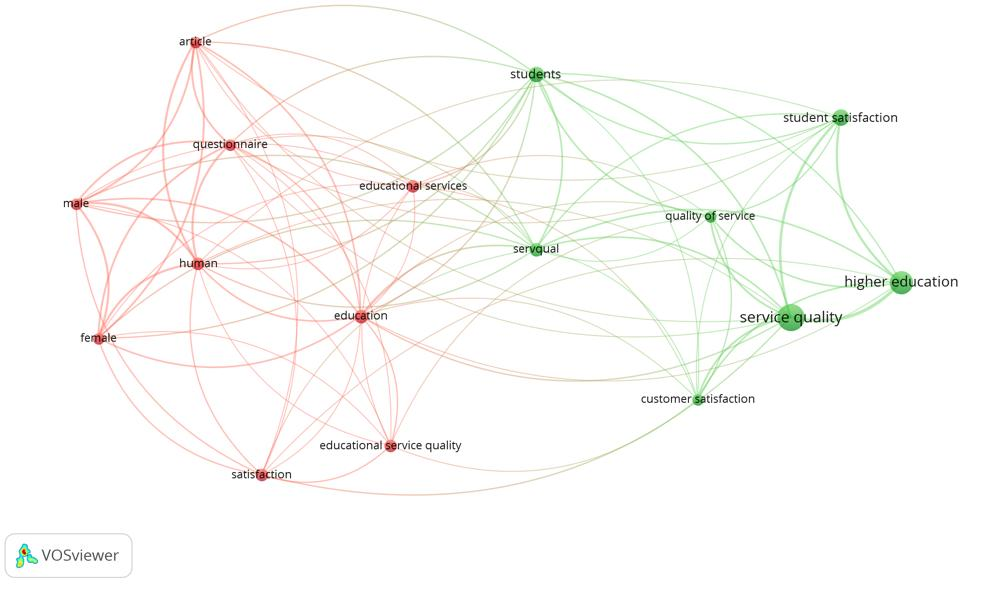
In contrast, the second cluster, represented in green, is more focused on conceptual and analytical aspects of service quality in education. Key terms in this cluster include service quality, quality of service, student satisfaction, higher education, students, customer satisfaction, and SERVQUAL. The presence of SERVQUAL as a central keyword indicates the widespread use of this model as a dominant framework for measuring service quality in educational institutions. Furthermore, the strong connections between service quality and student satisfaction highlight the critical relationship between service delivery and user perceptions, particularly in higher education settings. This cluster reflects a more structured and theory-driven research approach, emphasizing evaluation models and performance indicators.
The interaction between the two clusters suggests that the field is both methodologically and conceptually integrated, with empirical data collection approaches supporting theoretical models of service quality assessment. However, the visualization also indicates that the research is still largely cantered on traditional evaluation frameworks and survey-based methodologies. Advanced analytical approaches, such as data-driven modelling, decision support systems, and computational techniques, appear to be less prominent within the network. This finding highlights a significant research gap and suggests that future studies should focus on integrating more sophisticated analytical methods to enhance the robustness and applicability of educational service quality research.
The bibliometric coupling and keyword network analysis reveal a dual-structured research landscape, consisting of empirical and conceptual clusters that are strongly interconnected. This finding is consistent with previous bibliometric studies, which highlight that emerging research fields often develop through the interaction between data-driven empirical studies and theory-oriented frameworks. The prominence of keywords such as questionnaire, education, and demographic variables in one cluster confirms earlier research indicating that educational service quality studies are predominantly based on survey methods and perception-based measurements. At the same time, the presence of core concepts such as service quality, student satisfaction, and SERVQUAL in another cluster aligns with prior studies that identify SERVQUAL as one of the most widely used models for evaluating service quality in educational settings. Similar studies have also emphasized the strong relationship between service quality and satisfaction outcomes, particularly in higher education institutions, where student perceptions play a central role in assessing institutional performance. However, while previous research acknowledges the importance of integrating multiple evaluation dimensions, the current network structure suggests that the field remains largely dependent on traditional frameworks and lacks methodological diversification. In contrast to more advanced research domains that incorporate computational models, decision support systems [26], and big data analytics, the limited presence of such approaches in this study highlights a critical gap and suggests that future research should focus on integrating more sophisticated analytical techniques to strengthen the theoretical and methodological foundation of educational service quality studies [27].
3.3.Keywords Analysis
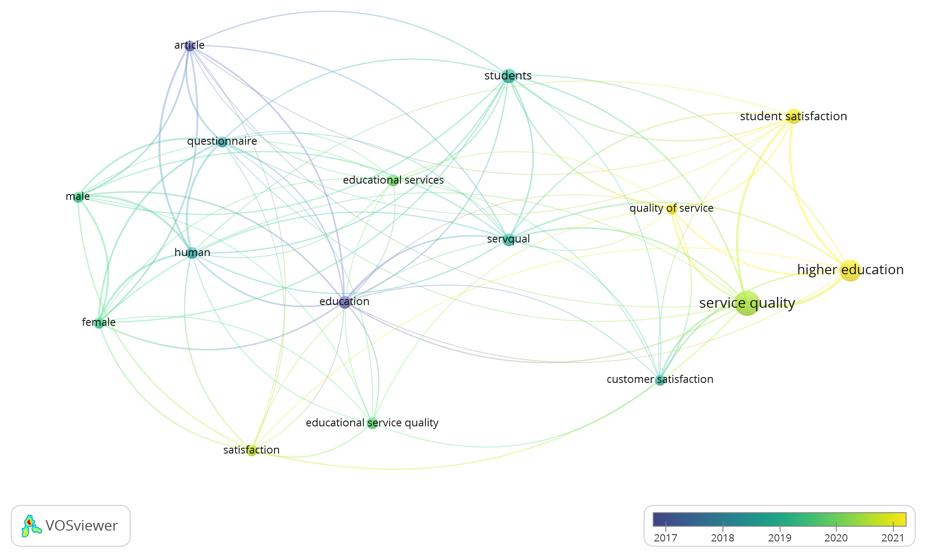
The overlay visualization of keyword co-occurrence provides a temporal perspective on the evolution of research themes in educational service quality (Fig. 3). The colour gradient, ranging from dark blue (earlier years) to yellow (more recent years), indicates the average publication year of each keyword, thereby revealing shifts in research focus over time. Early-stage research, represented by darker blue tones, is primarily associated with general and foundational terms such as education, article, and questionnaire. These keywords reflect an initial phase characterized by descriptive and survey-based studies, where the primary focus was on data collection methods and basic conceptual exploration of educational service quality.
As the field developed, a transition toward more structured and application-oriented research can be observed, indicated by green-coloured nodes such as students, SERVQUAL, educational services, and customer satisfaction. This stage represents the consolidation of theoretical frameworks and the increasing adoption of established models, particularly SERVQUAL, as a dominant approach for measuring service quality in educational contexts. The prominence of students within this phase highlights the growing emphasis on user-cantered evaluation and the role of stakeholders in assessing service effectiveness.
More recent research trends, represented by yellow-coloured nodes, are concentrated around keywords such as service quality, quality of service, student satisfaction, higher education, and satisfaction. These findings indicate a shift toward outcome-oriented and performance-based evaluation, with a strong focus on the relationship between service quality and user satisfaction in higher education institutions. The increasing centrality of these keywords suggests that contemporary research is moving beyond basic measurement toward understanding the impact and effectiveness of service delivery.
Despite this progression, the overlay visualization also reveals a notable limitation in the current research landscape. The absence of strongly emerging keywords related to advanced analytical techniques, such as data analytics, machine learning, or decision support systems, indicates that the field remains largely grounded in traditional evaluation approaches. This gap highlights an important opportunity for future research to integrate more sophisticated, technology-driven methodologies to enhance both analytical rigor and practical applicability.
The temporal evolution of keywords, as indicated by the overlay visualization, demonstrates a clear progression from foundational and descriptive research toward more outcome-oriented and performance-based studies. Early-stage keywords such as education, article, and questionnaire reflect a phase dominated by exploratory and methodological studies, which is consistent with prior research indicating that new fields typically begin with descriptive and data collection-focused approaches. As the field matured, the emergence of keywords such as SERVQUAL, students, and educational services suggests the consolidation of theoretical frameworks and the adoption of standardized measurement models, a trend that has been widely reported in the literature on service quality assessment [28][29][30]. More recent keywords, including service quality, student satisfaction, and higher education, indicate a shift toward evaluating the outcomes and impacts of service delivery, particularly in the context of institutional performance and stakeholder satisfaction. This progression aligns with previous studies that emphasize the increasing importance of user-cantered evaluation and evidence-based decision making in education. Nevertheless, the absence of emerging keywords related to advanced technologies, such as machine learning, artificial intelligence, and data analytics, contrasts with trends observed in other fields where digital transformation has significantly influenced research development. This suggests that educational service quality research has not yet fully embraced technological innovation, thereby presenting a substantial opportunity for future studies to incorporate data-driven and computational approaches to enhance analytical depth and practical relevance.
4.Conclusion
This study provides a comprehensive bibliometric and science mapping analysis of educational service quality research indexed in the Scopus database between 2011 and 2026. The findings demonstrate that research in this field has experienced substantial growth, particularly after 2019, indicating increasing scholarly attention toward quality assurance, student satisfaction, and institutional performance within educational settings. The bibliometric mapping further reveals that the intellectual structure of the field is strongly dominated by traditional service quality frameworks, particularly SERVQUAL and perception-based evaluation approaches, while research collaboration patterns remain relatively fragmented across authors, institutions, and countries.
The results also indicate that educational service quality research is highly concentrated within social sciences and management disciplines, with limited integration of computational and analytical approaches from data science, artificial intelligence, and decision sciences. Keyword evolution analysis shows that current research trends increasingly emphasize outcome-oriented evaluation and student satisfaction in higher education contexts. However, the relatively low presence of emerging themes related to learning analytics, predictive modelling, machine learning, and intelligent decision support systems suggests that the methodological development of the field remains limited and has not fully adapted to the growing digital transformation in education systems.
From a practical perspective, the findings provide several important implications for researchers, educational institutions, and policymakers. First, the fragmented collaboration network identified in this study suggests the need to strengthen international and interdisciplinary research partnerships, particularly between researchers in education, management, computer science, and data analytics. Second, the dominance of traditional survey-based approaches indicates that educational institutions still rely heavily on perception-based evaluation systems, which may not fully capture the complexity of educational service performance. Therefore, institutions should begin integrating data-driven evaluation systems, learning analytics, and digital service monitoring frameworks to improve evidence-based decision-making processes. Third, the concentration of research on student satisfaction indicates that other important dimensions, such as digital service accessibility, adaptive learning environments, institutional resilience, and AI-supported educational services, remain underdeveloped and require greater scholarly attention.
Despite its contributions, this study has several limitations. The analysis relied solely on the Scopus database, which may have excluded relevant publications indexed in other databases such as Web of Science, ERIC, or Dimensions. In addition, the study included only English-language journal articles, potentially limiting the representation of regional or non-English research contributions. The findings are also dependent on the selected keywords and search strategy, meaning that some relevant studies using different terminology may not have been captured in the dataset.
Based on these limitations and findings, several directions for future research are recommended. Future studies should expand bibliometric coverage by integrating multiple databases to obtain a more comprehensive representation of the field. In methodological terms, researchers are encouraged to incorporate advanced analytical approaches such as machine learning-based topic modelling, natural language processing, sentiment analysis, and predictive analytics to explore educational service quality from more dynamic and data-intensive perspectives. Future research should also investigate the implementation of intelligent decision support systems, educational dashboards, and AI-driven service evaluation frameworks within higher education institutions. Furthermore, comparative cross-country studies and longitudinal analyses are needed to better understand how educational service quality evolves across different educational systems, policy environments, and technological contexts.
Author Contribution: All authors contributed equally to the main contributor to this paper. All authors have read and agreed to the published version of the manuscript.
Funding: This research received no external funding.
Conflicts of Interest: The authors declare no conflict of interest.