
Vol. 4, No. 1, 2026, pp. 50-60
ISSN 3030-9174
https://ejournal.jtped.org/ojs/index.php/jtped
Educational Games and Game-Based Learning in Indonesian Education: Trends, Themes, and Emerging Topics
b Universitas Ahmad Dahlan, Jl. Ahmad Dahlan No. 44, Yogyakarta 55166, Indonesia
c Universitas Islam Negeri Maulana Malik Ibrahim Malang, Jl. Gajayana No. 50, Malang 65144, Indonesia
d Independent Researcher, Australia
e Universitas Islam Negeri Sunan Kalijaga Yogyakarta, Jl. Marsda Adisucipto No.1, Yogyakarta 55281, Indonesia
1 zafrullah.2022@student.uny.ac.id; 2 2400018226@webmail.uad.ac.id; 3 250104320003@student.uin-malang.ac.id; 4 rahayunurfadillahhh@gmail.com;
5 24106060015@student.uin-suka.ac.id
* Corresponding Author
Article history Received May 01, 2026
Revised June 28, 2026
Accepted July 10, 2026
Game-Based Learning;
Bibliometric Analysis;
Educational Technology;
Indonesia
Educational games and game-based learning have gained increasing attention in educational research because of their potential to enhance student engagement, motivation, and learning outcomes. This study aims to map the development of educational games and game-based learning research in Indonesian education and provide an overview of its intellectual structure. A bibliometric approach was employed using data retrieved from the Scopus database, with article selection conducted systematically through the PRISMA framework, resulting in 197 articles published between 2011 and 2026. Publications indexed in 2026 were included up to the data retrieval date and may therefore represent a partial indexing year. Data were analyzed using R Program and VOSviewer through publication trend analysis, word cloud visualization, keyword clustering, and keyword novelty analysis. The findings show a substantial increase in research output, reaching its highest level in 2025. Four major thematic clusters were identified: Digital Learning Ecosystems, Educational Technology Integration, Immersive Game Development, and Instructional Design Frameworks. The research landscape is strongly associated with gamification, learning systems, and game-based learning, while "Augmented Reality," "Project-Based Learning," and "Educational Technology" emerged as growing research topics. This study contributes by revealing the thematic evolution, intellectual structure, and emerging directions of the field, providing insights for researchers, educators, curriculum developers, and policymakers to support evidence-based implementation of game-based learning in Indonesian education.

1.Introduction
Education is a planned and ongoing process to develop an individual's potential, enabling them to acquire the knowledge, skills, attitudes, and values necessary for life [1][2]. Through education, students are guided to achieve optimal intellectual, social, emotional, and moral development [3]–[5]. Education also plays a crucial role in developing high-quality human resources capable of adapting to changing times [6][7]. Furthermore, education provides every individual with the opportunity to improve their quality of life and contribute to community and national development [8][9]. Schools are one of the institutions that play a crucial role in providing education.
Schools are formal educational institutions that serve as a place where the teaching and learning process takes place in a structured and systematic manner [10]–[12]. Students acquire a variety of knowledge, skills, values, and experiences that support their development [13]–[15]. Schools also play a role in character formation, instilling social values, and preparing students to face the challenges of future life [16][17]. In carrying out their functions, schools involve various components, such as educators, students, curriculum, facilities, infrastructure, and a mutually supportive learning environment [18][19]. The innovations widely applied in learning is educational games and game-based learning.
Educational games are games specifically designed to support the achievement of learning objectives by integrating educational and entertainment elements in a single medium [20]–[22]. The use of educational games can increase student motivation, engagement, and interest in learning by providing a more interactive and enjoyable learning experience [23][24]. Meanwhile, game-based learning is a learning approach that utilizes games as the primary tool in the learning process to help students understand concepts, develop skills, and achieve specific competencies [25][26]. This approach allows students to learn through direct experience, challenges, and problem-solving within the game [27]. Therefore, educational games and game-based learning are increasingly being utilized as learning innovations that can improve the effectiveness of the learning process at various levels of education.
The rapid development of research on games in education has prompted the need for bibliometric analysis to comprehensively map trends, themes, and directions of research development. Various studies have examined topics such as role-playing games, game design for older adults, video games in language learning, and game-based learning in engineering education, utilizing bibliometric approaches to identify publication patterns, author contributions, research themes, and emerging topics [28]–[31]. Previous bibliometric studies have explored educational games and related fields in various contexts, including role-playing games, serious games, video games in language learning, and engineering education. These studies have provided valuable insights into publication trends, collaboration networks, and thematic developments. However, most investigations have focused on global or discipline-specific perspectives, leaving limited understanding of the Indonesian research landscape. Despite the growing number of publications on educational games and game-based learning, little is known about how this field has evolved within the Indonesian context. Publication growth, thematic evolution, dominant research topics, collaboration patterns, and emerging research directions remain insufficiently documented. Consequently, a comprehensive bibliometric mapping is needed to better understand the intellectual structure and development trajectory of this field in Indonesia.
This study contributes to the literature in three ways. First, it provides a comprehensive bibliometric mapping of educational games and game-based learning research conducted by Indonesian-affiliated authors. Second, it identifies the intellectual structure and thematic evolution of the field through keyword clustering and novelty analysis. Third, it offers evidence-based insights that can support researchers, educators, curriculum developers, and policymakers in advancing game-based learning practices and future research agendas.
2.Method
This analysis aims to identify publication developments, research trends, thematic structures, and the direction of research on gamification in education through bibliometric analysis. Bibliometric analysis is a quantitative research method used to analyze scientific literature based on publication characteristics, citations, relationships between documents, and the interrelationships between keywords in a research field [30]–[34]. Through this approach, researchers can obtain a comprehensive picture of research development patterns, dominant themes, knowledge networks, and research opportunities that can still be developed in the future. Before conducting bibliometric analysis, a systematic identification and selection process of relevant articles was carried out using the PRISMA (Preferred Reporting Items for Systematic Reviews and Meta-Analyses) method (Fig. 1).
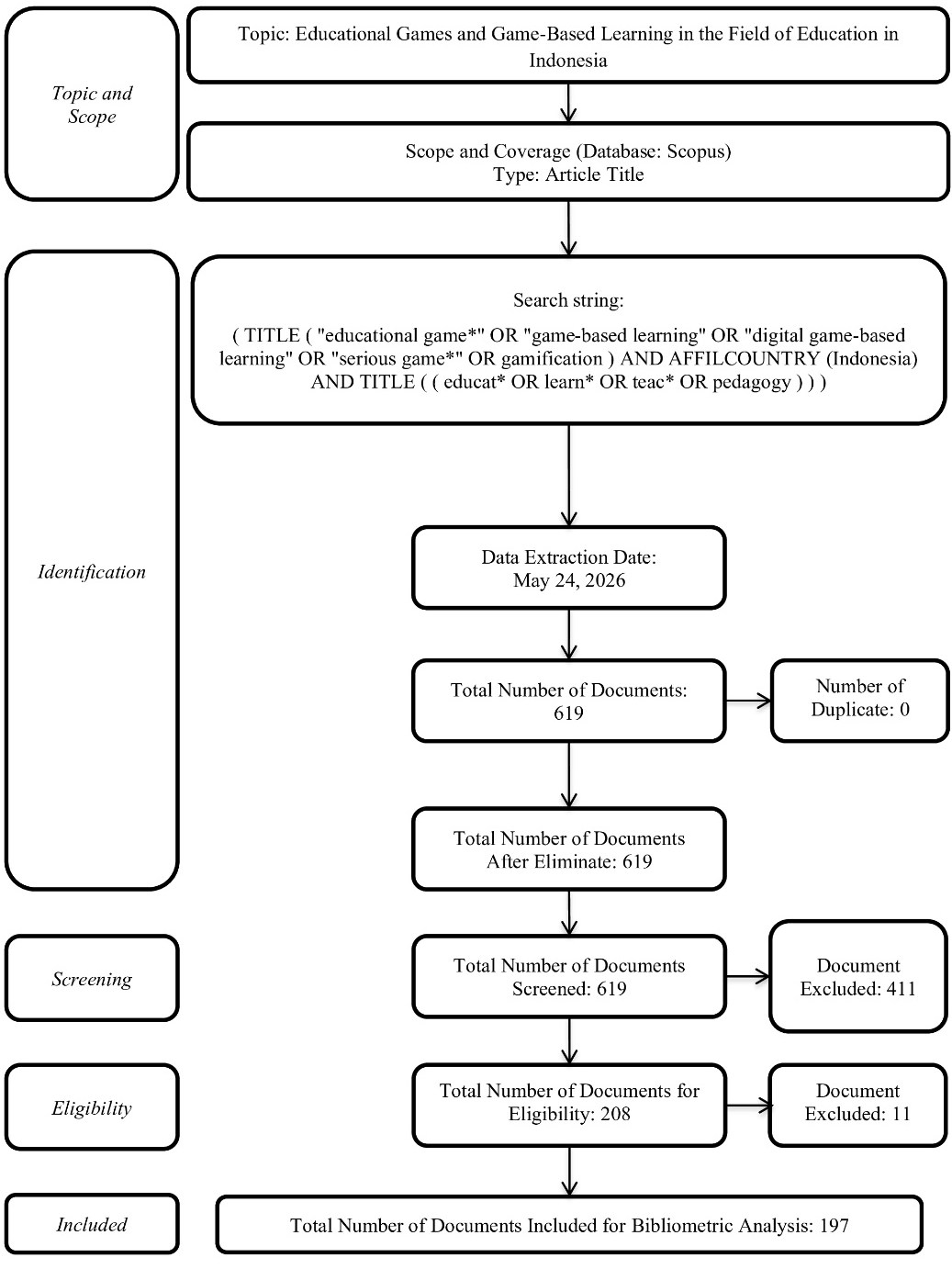
The PRISMA procedure is clearly presented, and the search strategy is explained. However, the search query appears to focus partly on gamification, while the title emphasizes educational games and game-based learning, creating a potential inconsistency. The authors should clarify the relationship among educational games, game-based learning, and gamification in the search strategy and analysis. In the identification stage, articles were collected through a search of the Scopus database using keywords related to educational games, game-based learning, digital game-based learning, serious games, and gamification in the field of education in Indonesia. The search was conducted on May 24, 2026, limiting the types of documents to articles indexed by Scopus. Data were retrieved in May 2026. Publications indexed during 2026 may not yet represent a complete publication year. The initial search results yielded 619 documents, and no duplicate documents were found, so all documents were retained for the next process. The next stage was screening, which is the selection of documents based on predetermined criteria, including the field of study of Social Sciences, the type of document, and the publication language (English). After the screening process was carried out, 411 documents were excluded, leaving 208 documents that met the initial criteria.
In the eligibility stage, all remaining documents were manually reviewed by reading the titles and abstracts, and their relevance to the research topic to ensure relevance to the study of educational games and game-based learning in education in Indonesia. This process aimed to eliminate articles that were still identified as less relevant to the research focus despite meeting the criteria in the previous stage. The examination results indicated that one document did not meet the eligibility criteria and was therefore removed from the dataset. Thus, 197 articles were declared to meet all criteria and were subsequently included in the inclusion stage for analysis using a bibliometric approach. This systematic selection process ensured that the data used in the analysis was of high relevance, quality, and appropriateness to the research objectives.
Data that met the inclusion criteria were analyzed using the R Program and VOSviewer software to obtain a comprehensive overview of research developments in the field under study. The analysis was carried out through several stages, including main information to identify general characteristics of publications, publication trends to analyze the development of the number of publications over time, word clouds to visualize the most frequently used keywords, keyword grouping to identify research theme groups based on co-occurrence relationships between keywords, and keyword novelty to identify the latest emerging research topics. The combination of the two software allows bibliometric analysis to be carried out systematically, visually, and in-depth so that it is able to describe the structure of knowledge, research trends, and the direction of study development in the research field being analyzed.
3.Results and Discussion
3.1.Main Information
Based on the main information results (Fig. 2), the research on educational games and game-based learning in Indonesia analyzed covers the period 2011–2026 with a total of 197 documents originating from 109 publication sources. All documents were written by 720 authors with only 9 documents written by a single author, indicating that collaboration is a key characteristic in this research field. The level of international collaboration was recorded at 18.78%, with an average of 4.13 authors in each document. In addition, there are 584 author keywords used in the publications and supported by 8,044 references that form the basis of the research. This field of study shows an annual growth rate of 17.33%, with an average document age of 3.59 years and an average of 8,447 citations per document, indicating quite rapid research development and a relatively good level of academic attention to the topic.

3.2.Publication Trends
Based on annual publication trends from Fig. 3, research on the topic under study showed fluctuating developments in the initial period. There were no publications in 2012 and 2014, while the number of publications in 2011 and 2013 was only one article each. From 2015 to 2019, there was a gradual increase, from three publications to 12. This increase indicates that academic attention to the topic is starting to grow and gain a place on the educational research agenda. Entering 2020, the number of publications increased significantly and continued to grow in subsequent years.
Research productivity peaked in 2025, with a total of 46 publications, making it the year with the highest contribution during the observation period. Despite a slight decrease in 2023 and 2024 compared to the previous trend, the number of publications remained at a relatively high level. Meanwhile, the number of publications in 2026, which was still recorded at 11 articles, was likely influenced by the incomplete indexing process, as the year was still ongoing. These findings indicate that this research field still has strong appeal and promising development prospects.

3.3.Word Cloud
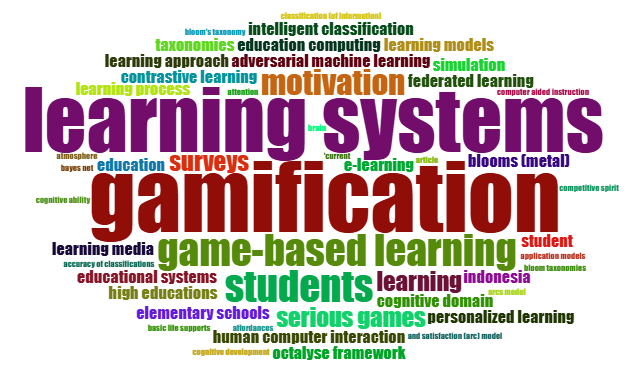
Based on the word cloud visualization (Fig. 4), the most dominant keyword is "gamification" with a frequency of 11 occurrences, followed by "learning systems" (10), "game-based learning" (5), and "students" (5). The dominance of these keywords indicates that research in this field focuses heavily on the application of gamification in learning systems and its relationship to students' learning processes. In addition, the emergence of the keyword "motivation" (4) indicates that increasing learning motivation is one of the frequently studied themes. Other keywords such as "learning" (3), "serious games" (3), and "surveys" (3) show attention to the use of educational games and survey approaches in evaluating the implementation of gamification-based learning.
On the other hand, there are several keywords with lower frequencies, such as "adversarial machine learning" (2) and "blooms (metal)" (2), which indicate the relationship of research with aspects of artificial intelligence technology and learning classification frameworks. The relatively small appearance of other keywords, such as "educational systems", "learning media", "cognitive domain", "online learning", and "Octalyse Framework", indicates the diversity of themes that support the development of gamification studies in education. Overall, the keyword map shows that the main focus of research is on the integration of gamification in learning environments to support student engagement, motivation, and learning experiences. The structure of keyword relationships also shows that gamification studies are developing multidisciplinaryly by involving pedagogical, technological, and psychological aspects in the learning process.
3.4.Keyword Grouping
Keyword clustering (Fig. 5) in VOSviewer aims to identify research themes with conceptual links based on the co-occurrence of keywords in scientific publications. Through this clustering, researchers can understand the structure of knowledge, the main focus of studies, and the direction of research development in a field more systematically and comprehensively. Next, the authors conducted a co-occurrence analysis to identify the relationships and interconnections between keywords used in research publications. The results of the keyword grouping based on the VOSviewer analysis are presented in detail in Table 1 to show the research themes formed within the field of study.

| Cluster Name | Number of Keywords | Keywords | Group Name |
|---|---|---|---|
| Red | 11 | E-Learning, Gamification, Higher Education, Learning Management System, Learning Outcomes, Octalyse Framework, Online Learning, Programming Learning, Project-Based Learning, Self-Directed Learning, Student Engagement | Digital Learning Ecosystems |
| Green | 11 | Artificial Intelligence, Augmented Reality, Education, Educational Technology, Engagement, Game, Learning, Learning Motivation, Local Wisdom, Motivation, Technology | Educational Technology Integration |
| Blue | 10 | Android, Critical Thinking, Educational Game, Educational Games, Elementary School, Framework, Game Development, Reading Comprehension, Serious Game, Virtual Reality | Immersive Game Development |
| Yellow | 7 | Design, Game Based Learning, Learning Media, Learning Systems, Mathematics, Simulation, Students | Instructional Design Frameworks |
The cluster titled "Digital Learning Ecosystems" illustrates the research focus on the development and implementation of gamification in the increasingly digital learning environment. Studies in this cluster highlight how various learning platforms, learning management systems, and technology-based learning approaches are being utilized to create more effective and engaging learning experiences. Research in this cluster also focuses on efforts to increase active student participation through various learning strategies that encourage independence, collaboration, and engagement in the learning process. Furthermore, attention is paid to evaluating the effectiveness of gamification implementation in supporting the achievement of learning objectives and improving learning outcomes. Thus, this cluster represents the transformation of education toward a digital learning ecosystem that utilizes game elements as a means to enrich the learning experience and improve the quality of learning.
Unlike the previous cluster, the cluster titled "Educational Technology Integration" emphasizes the integration of modern technology as a key supporter of gamification implementation in education. Research in this cluster demonstrates that technological developments have opened up new opportunities to create more interactive, adaptive, and student-oriented learning environments. Various studies explore how technology can be used to increase learning motivation, strengthen student engagement, and create more personalized and contextual learning experiences. Furthermore, there is attention to the development of learning innovations that combine technological elements with social and cultural characteristics relevant to user needs. Overall, this cluster illustrates the critical role of technology as a catalyst in the development of innovative and sustainable learning practices.
Meanwhile, the "Immersive Game Development" cluster focuses on the development of educational games designed to create deeper, more engaging, and more meaningful learning experiences. Research within this cluster focuses on the design, development, and implementation of game-based learning media that utilize various digital technologies to support learning activities. The primary focus of the studies lies not only on the technical aspects of game development but also on how these games can be used to develop students' thinking skills, conceptual understanding, and academic skills. Furthermore, research within this cluster demonstrates efforts to provide more interactive learning experiences through the use of technology that can increase user engagement. Therefore, this cluster reflects the development of research that integrates elements of pedagogy, game design, and digital technology in creating effective learning media.
Overall, the four clusters demonstrate that research on gamification in education is evolving through various complementary perspectives, forming a comprehensive research ecosystem. The first cluster highlights the transformation of digital learning environments, the second emphasizes the use of technology as a driver of educational innovation, the third focuses on the development of educational games that support the learning process, and the fourth emphasizes the importance of learning design as the basis for gamification implementation. The interconnectedness between the clusters demonstrates that the development of gamification research is not solely oriented towards the use of game elements but also encompasses aspects of technology, pedagogy, learning design, and student learning experiences. This situation illustrates that gamification has developed into a multidisciplinary field of study that connects various approaches in an effort to improve the quality of education. Thus, the resulting cluster map provides an overview of the direction of gamification research development, which is increasingly broad, innovative, and integrated with the needs of 21st-century education.
3.5.Keyword Novelty
Keyword novelty analysis (Fig. 6) aims to identify emerging research themes and emerging topics of interest within a field of study. Through this analysis, researchers can understand current research trends and identify research development opportunities that still have room for future exploration.

Yellow keywords indicate topics that are relatively newer than other keywords in the research network. One keyword included in this category is "Augmented Reality". The emergence of this keyword indicates increasing research attention to the use of immersive technology to create more interactive and engaging learning experiences. This development indicates that the integration of visual and digital technologies is one of the current research directions in gamification studies in education. Furthermore, the focus on "Augmented Reality" reflects efforts to enhance student engagement and learning experiences through technological innovation.
Another recent keyword is "Project-Based Learning", which demonstrates a growing trend in research toward combining gamification elements with activity-centered learning approaches and project completion. The presence of this buzzword indicates that gamification is not only used to increase learning motivation but also to support the development of critical thinking, collaboration, and problem-solving skills. Research linking gamification with project-based approaches is growing in line with the needs of 21st-century learning, which emphasizes practical competencies and authentic learning experiences. Thus, "Project-Based Learning" has become a theme gaining attention in recent research developments.
Furthermore, "Educational Technology" has emerged as a relatively new keyword with a strong connection to the development of gamification research. The emergence of this keyword indicates that current research is increasingly oriented towards the use of educational technology as a means to optimize the implementation of gamification in the learning process. Overall, the presence of "Augmented Reality", "Project-Based Learning", and "Educational Technology" as the latest keywords indicates that gamification research is moving towards the integration of innovative technologies and more active learning approaches. These findings indicate that gamification studies are no longer limited to the use of game elements alone, but have evolved into part of the transformation of modern technology and learning strategies. Therefore, the development of these three keywords shows the direction of gamification research that is increasingly dynamic, adaptive, and relevant to the needs of today's education.
4.Conclusion
The analysis concludes that research on gamification in education has experienced significant development and shows increasingly diverse trends over time. Keyword analysis identified four main themes: digital learning ecosystems, educational technology integration, immersive educational game development, and gamification-based learning design. The findings indicate that research in this field largely discusses the application of gamification to increase student engagement, support digital learning, develop game-based learning media, and integrate innovative technologies into the educational process. Furthermore, the novelty analysis revealed that "Augmented Reality", "Project-Based Learning", and "Educational Technology" are relatively new and emerging themes in gamification studies. These findings indicate that gamification research is increasingly oriented towards utilizing advanced technologies and modern learning approaches to support more effective, interactive, and adaptive educational transformations.
Supplementary Materials: Not applicable.
Author Contributions: All authors contributed equally to the conception, design, analysis, interpretation of data, and preparation of the manuscript. All authors have read and agreed to the published version of the manuscript.
Funding: This research received no external funding.
Acknowledgments: The authors would like to express their gratitude to Universitas Negeri Yogyakarta for providing institutional support and facilities that enabled the completion of this research.
Conflicts of Interest: The authors declare no conflict of interest.